buy gold and silver bullion

Saturday, November 24, 2018

Prices When Gold Is Money

We are getting ahead of ourselves here. Gold does not circulate as money – yet. It might never do so. Perhaps the end of government currency, fiat money imposed on us by government laws, may never be replaced by what for millennia has been the people’s money, gold. Do we even wish it? Given what we have to do to get there, probably not.

It is hard to think of a life without Nanny State giving us her money-tokens to buy our sweets, telling us what to eat and what medicine to take. But Nanny State is getting long in the tooth. When she was younger, she was less controlling. Her constant refusal to allow us, the ordinary people, to do what we want is an increasing source of friction.

Growing numbers of us can see Nanny State should pack her bags. But Nanny State’s favourites are frightened at the prospect of no nanny. Those of us who want a life without Nanny State can’t agree what it should be, and don’t know what happens when she goes.

Above all, there’s a feeling our secure, controlled world is coming to an end. Increasing financial instability and economic uncertainty are our common destination. Nanny State has frittered away all our pocket money, and it turns out the cupboard is now bare.

We can see the state is irretrievably bust. But governments don’t go bust, economists tell us, because they just issue more money to pay the bills. This is wrong: it is going bust by other means, and those of us who don’t see it are driven by wishful thinking. Ultimately, government-issued money will reflect its issuer’s complete bankruptcy. And there’s no point in following up the collapse of one fiat currency with another. The Zimbabwe dollar is followed by the bond note, and Venezuela’s bolivar is being followed by the bolivar soberano. Bust is bust is bust. It is the logical outcome for all national currencies issued by spendthrift governments.

In the entire scope of human history, government money is always ephemeral. It dances above the water for a relative day or two before it is spent and dies. One day in the future, we will turn back to gold, as we always have in the past. Governments, as demonstrated by the Mnangagwa and Maduro regimes, will resist it to the bitter end. Like children robbed of all their pocket-money, the ordinary citizen will be left with nothing. The only exchangeable value will be gold, and probably silver as well.

Those who have gold will escape the poverty of those that don’t. In time it will begin to circulate as the gold haves buy things from the have-nots, and gradually with the wider distribution of gold a sense of normality will return. It matters not if we price things in gold-grammes, or whether a slimmed-down government gives it a name. Sovereigns, eagles, krugerrands. It matters not if we use them electronically, so long as the bullion is readily there, and all credit is repaid in physical gold.

This article explains how prices work in a world that trades using gold as money. It assumes all forms of cash and electronic money is gold in another guise. We assume there is no issuer risk, because there is no fiat money. To explain pricing in gold we must contrive an ideal. It is this ideal we will assume.
The basic role of money

Money’s basic function is to facilitate the exchange of goods and services, its role always being temporary. Both parties in a transaction must have faith that the money is readily accepted by everyone with whom they transact, and that means all those counterparties must have faith that their counterparties will accept it as well. This has always been gold’s strength. It is a considerable disadvantage of fiat money, whose acceptance is confined by national boundaries.

We exchange goods and services because it is infinitely more efficient to buy from others what we cannot provide for ourselves, or that to do so would waste our time unnecessarily. Instead, we specialise in our own production, selling it for money so we can buy all those other things. It means we must keep a small store of money, or at least a facility to access it, in order to satisfy our daily needs and wants. And who sets that amount? Well, we do as transacting individuals.

When we have a temporary surplus of money, such as from the sale of an asset, we reinvest it. Either we buy another asset, or we lend it to someone else (usually through an intermediary) for interest. It matters not whether it is fiat money or gold.

The general level of prices is set by the purchasing power of the money in which it is measured. The two most important variables are the quantity of money in circulation, and the relative average preferences that people have for holding money relative to goods. Of the two, changes in relative preferences have the greatest immediate impact on prices.

If people decide as a whole to reduce their preference for money, then the general level of prices will rise. Indeed, hyperinflation, described as a catastrophic rise in prices, is the visible symptom of a widespread flight out of money. In other words, preferences are to not hold any money at all and to get rid of it as quickly as possible.

Alternatively, if there is an increased preference for holding money, prices will fall. This additional preference for money can be expressed in two ways. It can be held as physical cash, or more commonly people increase their savings. An increase in savings generates a shift in production methods to compensate for the lower prices of consumer goods. The greater supply of capital for investment tends to reduce interest rates and alter the businessman’s calculations in connection with his production.

These are the considerations behind the deployment of money in a community, whether it is fiat money or gold. It is the way economic actors make best use of the money available, and in free markets, which have proved to be the most consistently progressive of systems, production does not need the stimulus of additional money to that already in circulation. That is a neo-Keynesian myth.

Trading with gold as money

People in a community, town, city or even a nation set their own monetary requirements. Let us assume that in doing so, the general price level, that is to say the balance of preferences for or against gold relative to goods, differs from that of a neighbouring population. In that case, an arbitrage will take place, whereby gold will flow to the community with the lower prices to pay for current consumption, so that the purchasing power of the gold in the two communities will tend to equate.

Additionally, gold savings will seek out the higher returns between the two centres and flow the other way from gold seeking lower prices. However, the quantities of gold held as savings are always significantly less than the quantities spent in consumption. In fact, the arbitrage takes place both through the trade of goods and also by the deployment of capital exploiting interest rates differentials, so that a balance in prices and interest rates is achieved.

It is therefore easy to see that in a commercial world with effective transport and communications, whatever the local preferences are for holding money relative to goods, multi-centre arbitrage tends to produce a common price level and a common level for interest rates. These adjustment factors are conducive to trade, not only between communities but between nations. And trade priced and settled in gold is, all else being equal, far more effective than when individual fiat currencies are involved, because with gold as the common money national boundaries are not a barrier and trade is truly global.

Given gold’s ubiquity as money, the effect of localised changes in general preferences for holding gold relative to goods can be regarded as minimal. An additional consideration is an underlying inflation of above-ground stocks of gold through mine supply, but this is broadly offset by population growth.

Technological innovation and improvement in production methods as well as competition all tend in the long run to reduce the general price level of goods and services. So, while there is little change in the general level of prices from the money side, there can be a significant reduction in prices over long periods of time from the goods side. The effect is to enhance the purchasing power of savings, leading to stable, low interest rates and the accumulation of private wealth.

- Source, James Turk's Goldmoney

Tuesday, November 20, 2018

The Psychology of Systemic Consensus

We are all too familiar with established views rejecting change. It has nothing to do with the facts. Officialdom’s mind is often firmly closed to all reason on the big issues. To appreciate why we must understand the crowd psychology behind the systemic consensus. It is the distant engine that drives the generator that provides the electricity that drives us into repetitive disasters despite prior evidence they are avoidable, and even fuels the madness of political correctness.

Forget the argument, look at the psychology

A human prejudice which is little examined is why establishments frequently stick to conviction while denying reasonable debate. Anyone who addresses the unreason of the establishment risks their motives being personally vilified and attacked. There are many fields of government where this is demonstrably true.

Leadership is too often based on prevailing beliefs, with minds firmly closed to any evidence they might be wrong. Even Galileo was forced by the Inquisition in 1633 to recant his scientific evidence that the earth revolved around the sun – a thoroughly reasonable and logical though novel proposition to the independent mind. But it wasn’t until 1992 that the religious establishment at the Vatican forgave him for being right.

That was 359 years later and long after it mattered to Galileo. Fortunately, when the establishment view departs from the facts it rarely survives as long. Socialism, economics, climate change and Brexit show the same static opinions insulated from inconvenient contradictions. This is not to say the establishment need be judgemental. Democratic government at its best tries to remain neutral and reflect a balance of opinion. But there are times when it loses sight of firm ground and becomes subverted by the psychology of its own established but unfounded beliefs.

The debate over Brexit is a classic illustration of psychology over reason, where few Remainers or Brexiteers have changed their views since the referendum in 2016. Influential Remainers are, by and large, those who have worked in government during the forty-five years of Britain’s increasing transfer of political power to Brussels. There are others who vehemently believe that being part of a larger economic unit is more secure than exposure to free markets. There are also those who believe Brexit will directly affect their lives and fear the uncertainty. Whatever their reasoning, their subconscious instinct is to seek protection in a guardian establishment rather than risk a commercially-based proposition.

The purpose of this article is not to debate Brexit, or any other government policy, but to explain the psychology of systemic consensus. Brexit is only an example of a wider phenomenon and serves as a topical example. This article expands the scope of the work of Pierre Desrochers and Joanna Szurmak, both of Toronto University, who examined the longstanding link between theories of overpopulation and climate change.[i] I argue that their thesis is also applicable to other instances of human debate, where psychological factors inhibit reason. Brexit will be our case study, being topical, but I shall refer to other examples as appropriate.
Brexit’s propositions

There are two main propositions upon which Brexiteers base their argument. The first is the loss of British sovereignty, by which they mean the right of the British electorate to determine its collective future. Traditionally, this has been the preserve of Britain’s parliamentary democracy, with an elected Parliament enacting all legislation which is then administered by the courts through criminal and civil law. These established democratic rights have been increasingly abrogated to an unelected executive in Brussels. True, there is a European Parliament to which the British electorate sends representatives, but it cannot initiate legislation, nor can it to all practical extent exercise control over the executive. The remote Brussels executive is also superior to national parliaments and imposes regulations which have to be adopted in national laws. The European Court of Justice is the supreme court, overruling national legal systems.

Being in the EU means the loss of democratic accountability for the British electorate. The Brexiteers say it is a simple matter of fact. Being out of the EU and reverting to full parliamentary accountability would be a return to long-standing democracy, which nearly everyone agrees is the best form of government.

The second major issue is arguably the lesser of the two, and that is whether Britain’s economic prospects are better in the European Union customs area, or independent from it. The empirical evidence is Britain did spectacularly well in the nineteenth century by removing all trade barriers and tariffs and having no trade agreements, owing its pre-WW1 global status almost entirely to unrestricted trade. The Brexiteers claim the economics supports the empirical, with EU trade in goods accounting for only 8% of Britain’s GDP, and declining relative to trade in goods with the rest of the world.

It is interesting to note that the Government’s economists and their supporters do not fully engage on the economic issue, with only the Brexit-supporting European Research Group (ERG) making the economic case seriously. This does not appear to be because of media focus. Rather, the economic establishment lost credibility at street-level by forecasting an economic slump in the event of Brexit. It was clear that the UK Treasury, the Bank of England, and the IMF set the inputs to their economic models in such a way that a Brexit outcome from the referendum would be dire. Instead, inward investment has increased, defying predictions that European and foreign corporations would sell up. The UK economy is now booming, despite the uncertainty over the Brexit negotiations.

In contrast with the ERG’s positive critique, the Remainers have continually resorted to scare tactics, such as claiming Calais will be shut to Dover’s shipping (denied by the Calais port authorities). They claim all flights from the UK to the EU and flights crossing EU territory will be threatened (ridiculous, being against international aviation law, and Britain’s Air Traffic Control controls transatlantic flights into Europe anyway). They claim that drugs for the NHS will be withheld (really?). And so on. All the establishment Remainers have done is resort to using fear as a substitute for debate.

Remainers have never adequately addressed the issue of democratic accountability either, presumably because they know they cannot win that debate. Instead they skirt round the issue. Logically, given the attestable facts on democracy and economics and having had two years to consider the democratic and economic issues, one would think increasing numbers of Remainers would accept their original position was untenable and revise their stance. Not so. They remain firm as ever, rather like the Vatican and its long-standing denial of Galileo’s discovery.

- Source, James Turk's Goldmoney

Wednesday, November 14, 2018

James Turk: Why Gold is Money and Will Always be Money


GoldMoney founder and bestseller author James Turk explains his view on the current global economy and gold market.

He explains why gold is and always will be money.


Monday, November 5, 2018

The Dollar Will Eventually Go Over the Cliff. You Can Rest Assured


The action is taking place over here in London. You are seeing this huge backwardation. If you want to put a big order in, say $50 million for physical metal, you can’t get that metal tomorrow. 

You are going to have to wait for a while before you can get that metal. That’s sign to me that gold is cheap. The same thing is happening in silver...


Saturday, October 27, 2018

James Turk: Massive Amount of Money Will Flow Into Gold

There is so much uncertainty prevailing these days, it is natural to move into physical gold. It’s safe-haven properties have been proven over thousands of years. The attraction of owning a safe asset is appealing as the financial risks grow. People are waking up to the fact that another bust in the credit cycle is long overdue. What’s more, the Federal Reserve is bringing that day closer by raising interest rates, which for now has kept the US dollar steady.

An Important Bull Market Indicator

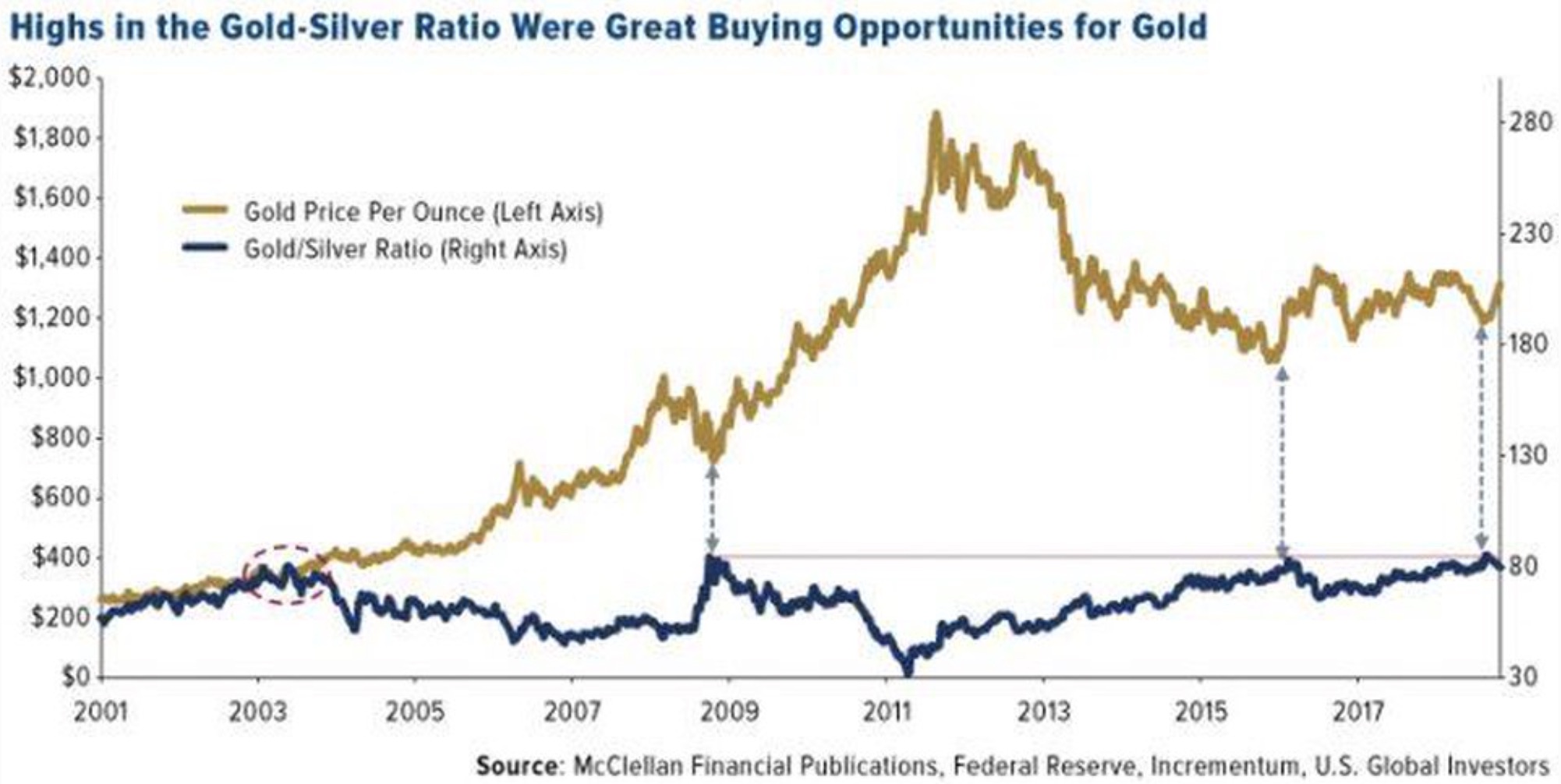
It worth noting that gold has been rising even though the US Dollar Index has remained above 95. That is comfortably above its critical support around the 94-to-93.50 area. So gold is moving higher against all currencies, which is an important bull market indicator. And silver is trading okay as well. Silver has not been strong enough to say that it is leading the precious metals higher, which is what I would like to see. But it is keeping up with gold. In fact, the gold/silver ratio has declined slightly from its high last month.


This Catalyst Will Create A Massive Upside Surge In Gold & Silver

Watch the 81 area. If the gold/silver ratio breaks below that level, then there is a good chance that silver will start leading. When that happens, the precious metals often start accelerating to the upside. I am expecting that the next few months will be good ones for the precious metals, Eric. The odds of that outcome increase if silver can hurdle above resistance at $15.

- Source, King World News, read more here

Monday, October 22, 2018

James Turk: This Catalyst Will Create A Massive Upside Surge In Gold and Silver

“The evidence is mounting, Eric, that the precious metals have turned the corner and are heading higher…

“Today in particular saw something very important – upside follow through. Gold rose 1.4% last week, and instead of falling back, gold had a good move up again today.

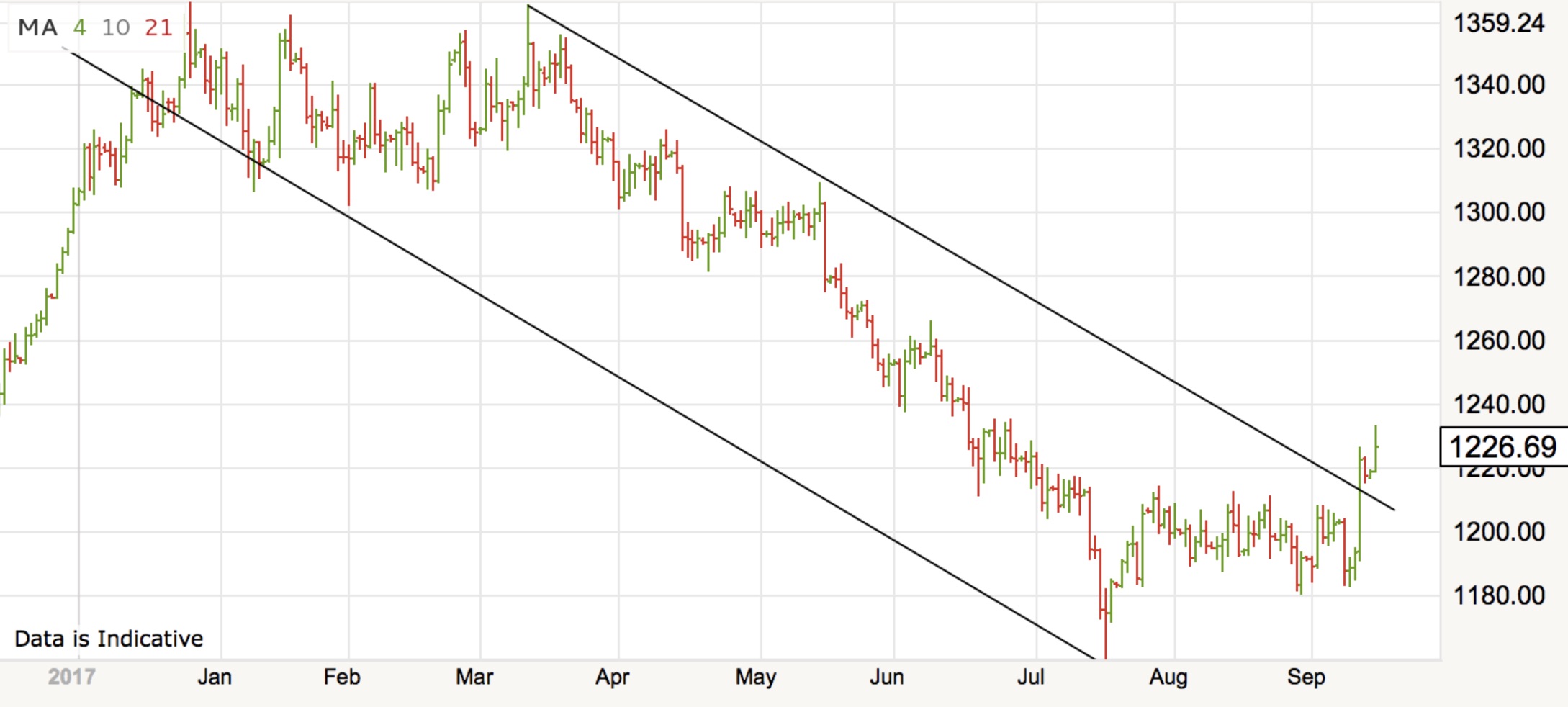
Upside follow through like this has been lacking for months. Its absence has discouraged gold bulls, which in turn resulted in selling pressure. As a consequence, and as we can see in the following chart, gold has been in a downtrend since early this year when it was unable to break above the $1,350 area.
Gold Has Broken Solidly Out Of Downtrend Channel


What we are seeing now is buying pressure. Support under $1,200 looks solid. Dips are well bid, and that result is not surprising...


- Source, King World News, Read More Here

Monday, October 15, 2018

US Dollar Weakening, Despite Interest Rate Increases

That is one ugly looking chart. Higher interest rates would mean a strong dollar, not the weak-looking one pictured in this chart. Not only is the dollar forming a huge top, its short-term moving average is rolling over, making it look like the dollar is going to fall off the edge of the table if support at current levels breaks. So maybe what this chart is telling us is that the Fed won’t be raising interest rates on Wednesday. Maybe the underlying buying pressure in the precious metals is also telling us the same thing. Regardless, any plan by the Fed to stop or even just delay any interest rate increases they have already telegraphed to the market will be very bullish for gold and silver.

Big News To Create Metals Spike?

So here are the big questions at the moment, Eric: Is this slow boil developing in the precious metals just a head-fake? Or are we at the beginning of a big upward jump in precious metal prices? Let’s see what happens on Wednesday, but this dollar chart and others are giving us the footprints of clairvoyant insiders. It looks like they have already been preparing for a few weeks that the Fed will not raise interest rates. That would be big news because it is contrary to what is expected, and big surprises like this cause volatility.

A Long Awaited Breakout

Here is what to watch: For several weeks now gold has been in a trading range of roughly $1,185 to $1,215. So gold needs to break out of that range. Let’s see if it prints $1,220, which could be the first step of a long awaited breakout.

- Source, James Turk via King World News

Thursday, October 11, 2018

A Major Gold and Silver Short Squeeze May Unfold On This Stunning Announcement

“The summer doldrums in the precious metals are over, Eric. Markets are heating up, and increased volatility across the board is likely as we move toward the end of the week…

First, Comex options expire tomorrow. October is not normally a big delivery month, so it should be relatively easy for the central planners and their friends in the big banks to control precious metal prices leading up to expiry like they have done so many times in the past.

Metals Short Squeeze?

Yet we saw good buying in the precious metals today, which resulted in noticeable upside pressure that moved the metals higher after their soft start in the morning in Europe. They moved back toward the top of their trading range, particularly silver. That raises some interesting questions. Are the bullion banks about to be overpowered by the buying coming into the precious metals? Or is it that the bullion banks are now on the long side and the hedge funds short, as some have speculated? If so, are the hedge funds about to be blindsided by a short squeeze in the precious metals?

There are more questions than answers at the moment, Eric, but look at what is happening to oil. It gives us a hint as to why the precious metals are turning higher. WTI is just a chip-shot away from its recent high of $74, which was a 4-year high. And over here in Europe, Brent crude is flirting with $80 a barrel, which is also right at a 4-year high. Rising crude oil prices provide solid evidence that inflation is creeping higher.

All of this is important, but the big news hits the wire on Wednesday afternoon. That’s when I expect the real volatility to start. The Federal Reserve on Wednesday is widely expected to announce another interest rate increase, but I have my doubts. Despite its claim to be independent, the Fed is fanatically political. For that reason, it does not raise interest rates too close to an election.

So is the Fed ready to risk the President’s ire by raising interest rates with the mid-term election looming? Maybe the answer lies in this chart of the Dollar Index...

- Source, James Turk via King World News

Sunday, October 7, 2018

Apocalypse, Or Not?

Members of the American libertarian movement, particularly extremist preppers, are often associated with a belief that a complete breakdown in society is the only outcome from government economic policies and will lead to complete social disintegration. At the centre of their concerns is monetary destruction, with other issues, such as the erosion of personal freedom and the right to bear arms, important but peripheral. 

They cite history, particularly the hyperinflationary collapses, from Rome to Zimbabwe, and now Venezuela. They draw on Austrian economic theory, which fans their dislike of government and their expectation of total chaos.

Properly reasoned economic theory certainly reduces the science to one of black and white conclusions, which suits conclusion-jumpers. But the whole point of it is to explain society’s errors, so that they may be corrected. It is only by understanding the errors of state intervention and socialism, both communistic and fascist, that solutions can be found. Solutions then need to be applied, not taken into a mountain or forest retreat never to be implemented.

The real world does not work on black and white economic theories. It progresses along a muddled course, torn between statist mistakes and society’s unending patience with government intervention. Governments are the source of all wars and wealth destruction, but societies tolerate them. Philosophers have argued over this from Plato versus Aristotle onwards, and we are still here, two and a half millennia later, chewing over the same bones.

History records our philosophical chewing, and Man’s continuing conflict with and tolerances of the state. It records the rise and fall of kings, emperors, dictators and governments. Hermits and other preppers come and go, either unrecorded or, like Saint Simeon Stylites, noted as little more than historical footnotes. To future generations, prepping will almost certainly be a bygone curiosity, and humanity will continue despite government suppression.

This article is an attempt to rationalise an apparently apocalyptic future into how it is likely to evolve over the coming years. In the absence of a nuclear Armageddon, what we fear, more than anything else, is actually uncertainty and change.
Out with the old

Uncertainty and change are with us all the time. In a truly free market economy we embrace it because they are driven by our personal economic interests, and it is a continual process. But the desire for change is driven by us only in our role as consumers; as workers or businessmen facing competition for our existing labour and skills we tend to resist it. It is that side of us that a government taps into.

Modern governments, except where they are overtly mercantilist, don’t do change. Their support, indeed their reason for being, is based on anti-progressive lobbying from both establishment businesses and socialistic pressure groups. Government economists do not recognise progress, living in a stagnant world of historical statistics. Progressive change interferes with their certainties and is therefore never properly considered.

This is what the welfare states in the West have become, societies managed by anti-progressive governments, nominally responsible to their electorates, but in fact with a life of their own. The interests of governments have long since departed from those of consumers and increasingly conflict with their needs and wants. It is a process that has evolved to the current position over the last hundred years, when governments had understood their role should be strictly limited to identifiable national interests, when government employees deferred to the general public as their civil servants, and importantly, when the national currency was based on money chosen collectively by individuals.

It is therefore a much larger issue than just money. It is about the direction of political travel. For individuals it has become a prolonged road to serfdom, where power and personal freedom have been sequestered by the government from the consumer. The consumer has lost the right to keep his own income, and his preferences are now regarded by the state as subject to its control, to plan and dispose of as it sees fit.

The so-called free world was first ruled by the British and then by the Americans. The roots of both regimes were trade, protected by a government enforcing the rules of property ownership, the certainties of contract law and laws that protected individuals in their interpersonal relationships. As law-makers, governments now legislate to extend control over their peoples. And now the American government, in the name of American business, is even directing its own citizens not to buy from foreigners and is taxing them if they do so.

It is not the first time the state has interfered with our preferences in this way. The lurch into protectionism that led to the Smoot-Hawley Tariff Act of 1930 was one example, and the nationalisation policies of Britain’s post-war government another. These were errors from which a retreat proved possible. Today, the West’s democratic system has reached a point from which no ordered retreat back to free markets, to personal freedom and to governments which serve the people and not themselves, seems possible. Change will only come from the ultimate collapse of a system that promotes interests over freedom.

- Source, James Turk's Goldmoney

Wednesday, October 3, 2018

Rescuing the Banks is More Complicated Than Last Time

We should take notice of a joint article by Ben Bernanke, Tim Geithner and Hank Paulson last week in the New York Times iii. It was effectively an admission that there will be another financial crisis, and as such, these three men who presided over the last one must be worried that we are now heading towards the next.

They point out that some of the tools they deployed ten years ago are no longer available. The critical paragraph is the following:

But in its post-crisis reforms, Congress also took away some of the most powerful tools used by the FDIC, the Fed and the Treasury. Among these changes, the FDIC can no longer issue blanket guarantees of bank debt as it did in the crisis, the Fed’s emergency lending powers have been constrained, and the Treasury would not be able to repeat its guarantee of the money market funds. These powers were critical in stopping the 2008 panic.

Their concern is that under current legislation and regulations, a similar crisis to Lehman would increase the risk of a total collapse of the financial system, because the financial authorities have their hands tied. While there is some truth in their concerns, they might be overcome by emergency executive orders from the president.

The authors are oddly silent on the larger problem that makes a globally coordinated financial and systemic rescue much more difficult, and that is the bail-in provisions adopted by all the G20 members and enshrined in their laws. Last time, bail-outs and nationalisation of the banks were the methods deployed, and they protected both depositors and bond holders. The cost was borne entirely by the state.

Without much thought, bail-in provisions were introduced specifically to prevent the cost of future bank failures being forced on the state, and instead the costs are to be shared by bond holders and uninsured depositors. Their application to individual failures of banks not deemed systemically important financial institutions is actually superfluous, because normal bankruptcy laws are sufficient for these instances. The difficulty occurs when a potential bank failure threatens to escalate into a systemic threat. But if you bail in such a bank, by forcing losses upon bond holders and uninsured depositors, you simply escalate a systemic problem.

The three men at the center of the Lehman crisis appear to have learned little from their experience. The overriding lesson is of the futility of closing some stable doors while opening others.

- Source, Alasdair Macleod via James Turk's Goldmoney

Friday, September 28, 2018

The Dollar is Central to the Next Crisis

It is now possible to pencil in how the next credit crisis is likely to develop. At its centre is an overvalued dollar over-owned by foreigners, puffed up on speculative flows driven by interest rate differentials. These must be urgently corrected by the European Central Bank and the Bank of Japan if the distortion is to be prevented from becoming much worse.

The problem is compounded because the next crisis is likely to be triggered by this normalisation. It can be expected to commence in the coming months, even by the year-end. When flows into the dollar subside and reverse, bond yields can be expected to rise sharply in all the major currencies. There will also be a number of other unhelpful factors, particularly rising commodity prices, the timing of the Trump stimulus and trade tariffs pushing up price inflation. Coupled with a declining dollar, price inflation and therefore interest rates are bound to rise significantly.

Then there is another problem: when it comes to rescuing the global financial system from the systemic fall-out, not only will the challenge be greater than at the time of the Lehman crisis, but legislative changes, such as confusing bail-in provisions, have made it more difficult to execute.

There is also evidence that during the last credit crisis in 2008, the Russians were tempted to interfere with the Fed’s rescue attempts, potentially crashing the whole US financial system. At that time, they failed to get the support of the Chinese. Now that Russia has disposed of most of its dollar investments in return for gold, and following an escalation of geopolitical conflicts, a new financial crisis may be regarded as an opportunity by America’s enemies to emasculate America’s financial and geopolitical power.

The outlook for the dollar and all dollar-dependent assets is not good. The only protection will be the possession of physical gold and silver, beyond the reach of systemically-threatened banks.

Mega-currency strains

The chattering classes in financial markets have droned on and on about how the Fed’s interest rate policies are creating crises in emerging markets. But emerging markets are likely to be just bit players in a new global tragedy. As Shakespeare put it in Macbeth, they are “but walking shadows, a poor player who struts and frets his hour upon the stage, and then is heard no more….”

In the process the real problem has been under-reported, and that is the strains between the mega-currencies: the dollar, the euro and the yen. Could they be the leading players in the next credit crisis, and if so how will the tragedy unfold?

You only have to note the disparity in bond yields, particularly at the short end of the yield curve, to see what is moving money. Two-year US Treasuries yield 2.74%, while the two-year German bund yields minus 0.55%. Two-year JGBs at minus 0.12% are also out of whack with USTs. You do not get disparities like this at the short end of the yield curve without moving massive quantities of short-term money.

Putting currency risk to one side for a moment, a Eurozone bank, insurance company or pension fund is taxed on short-term investments in bunds through negative yields, while being offered a tempting and potentially increasing yield on similar risk USTs.

Tempting, isn’t it?

Obviously, we can’t ignore currency risk. For simplicity, we will assume that fully matched risk insurance more or less eliminates the profit opportunity. It is possible to use out-of-the-money currency derivatives to cap the risk, and indeed, that’s one reason why OTC foreign currency derivatives stood at over $87 trillion in the second half of last year.

But we digress slightly. Maximum profits are obtained by taking a naked punt, and here, the trend is your best friend. If you feel sure the dollar is going up against the euro, not only will a euro-based financial institution gain more than three per cent by holding two-year USTs over equivalent sovereign risk two-year bunds, but there is the juicy prospect of a currency gain as well. We will also note that the Fed still plans to raise interest rates while the ECB does not. That should ensure currency risk is kept safely at bay.

Euro-based financial institutions must be sorely tempted. Furthermore, the dollar stopped falling in April and since then its trend has been up. Talk in the market is of dollar shortages as emerging-market governments may be forced to cover dollar liabilities, which coupled with Fed-induced interest rate rises makes further dollar gains against the euro, and even the yen, appear to be a racing certainty.

Convinced yet?

- Source, Alasdair Macleod via James Turk's Goldmoney