buy gold and silver bullion

Wednesday, July 31, 2019

The Reasoning Behind Gold’s Breakout

Gold’s dramatic move above $1400 has caught the investment establishment by surprise. Physical gold ETFs, as a proxy for direct portfolio investment, amount to only 0.05% of the estimated $250 trillion of global investment values. As well as being badly wrongfooted, investment managers have little understanding of the role of gold as money, believing it to have no role in the monetary system. They will have to undergo a rapid re-education. This article addresses their common misconceptions.


Introduction

One month ago, gold made a dramatic move above a three-year consolidation (delineated by the pecked lines in Chart 1), confirming for technical analysts that a bull market in gold dating from the December 2015 low at $1,050 is alive and well. Chart 1 shows that a basing process has actually been in train for over six years, highlighted by the lower rectangular box.

Technically, the post-Lehman crisis bull market, when gold more than doubled, was ripe for a set-back. After peaking at $1920 intraday in September 2011, the Cyprus banking crisis in 2012 failed to collapse the Eurosystem and the gold price fell heavily. The topping-out process is highlighted by the upper smaller box in the chart. But that is now irrelevant. What is relevant is gold appears to be breaking out of a multiyear base, solid enough to offer the prospect of a potentially strong bull market in the dollar price of gold.

For trend-chasing investors who form a large majority by sheer weight of managed money, this is the primary consideration. They will have ignored the debate about the weaknesses of fiat currencies, geopolitical tensions with the Asian superpowers and America’s acts of trade immolation. That was always going to be the case until such time as gold broke convincingly through the $1350 technical price ceiling. With the price now establishing itself at over $1400, an appraisal of the reasoning behind gold’s breakout is timely for these investors.

The dollar price is no more than a headline indicator for investors whose portfolio performance is not measured in dollars. Gold’s performance measured in other currencies has been far better. Since the price peak in September 2011, by mid-December 2015 the dollar price of gold had lost 45% of its value and has recovered to a net loss of only 24%. The gold price measured in the other major three currencies has performed significantly better, with the price in Japanese yen even higher now than it was at the time of the dollar’s 2011 all-time high. This is shown in Chart 2.


Furthermore, while the dollar price has only just caught the attention of mainstream dollar investors, residents of Euroland and Britain have seen gold in euros and sterling recover to within six and four per cent of the 2011 high respectively. Nearly three months ago, it was said that the gold price in 72 currencies stood at all-time highs. Given that emerging market and developing economy currencies tend to be weaker than the majors it is probably true.

Those who watch dollar headlines before jumping on a trend are late arrivals to a party already in full swing. Since the dollar price of gold bottomed in late-2015, the sterling price aided by the Brexit debacle has risen 63%, proving to be an excellent hedge against a falling pound. Gold priced in euros is up 45% from its lowest point, proving the wisdom of ordinary Germans who are the largest group of gold buyers in the Eurozone.

At a time of zero and negative interest rates and bond yields, these returns are doubly impressive. But there are remarkably few bulls on board with reasonable portfolio exposure. According to the World Gold Council, at end-June gold ETFs held 2,548 tonnes of bullion worth $115bn at current prices. While there are other gold-related regulated investments and derivatives, this feedstock of the raw stuff is tiny compared with the total value of global portfolio assets, which is probably in excess of $250 trillion.[i] Given that nowhere is physical bullion a regulated investment, direct holdings of vaulted investment bullion are unlikely to be significant in this context. Putting physical gold being held as an unrecorded asset to one side, to find physical gold in investment portfolios you have to dig very deep. On these figures, ETF bullion represents only 0.046% of estimated global portfolio values.

Estimates of physical exposure in portfolios should not be taken too literally, but from these estimates we can see that for all practical purposes gold’s breakout has left the trend-chasing establishment with almost nothing. For this reason, there is now likely to be a scramble to understand why gold has broken out. Portfolio managers will be keenly aware they are likely to come under pressure from clients to participate and will want to have answers.

This article is addressed to the portfolio managers and investors who are in the unfortunate position of not yet owning any gold or find themselves underweight in gold-related investments and are considering what to do about it. But first we must dispel some of the common myths about the role of gold, so we can approach the subject with clarity.

- Source, James Turk's Goldmoney

Friday, July 19, 2019

Current Gold Price Cycle Started at the End of 2015…

Since we have presented our gold price framework the first time in late 2015, we have argued that we have entered a new cycle in the gold market. At the time we believed that longer-dated oil prices (5-year forward Brent) had likely set a bottom in late 2015 (at US$47/bbl, now US$60/bbl) and that real-interest rate expectations (10-year TIPS yields) were close to their cycle peak at 0.8% (now 0.3%) (see Exhibit 2). Our view was that – while there was some room to the downside – risk for gold prices were clearly skewed to the upside. While we weren’t extremely bullish near term for longer dated energy prices[1], the reason for our bullish view on gold was that we saw much more downside risk than upside risk for real-interest rate expectations.


By the end of 2015, the FOMC members were predicting terminal Fed funds rates at 3.5% (see Exhibit 3). The Fed also has a PCE (Personal Consumption Expenditure) inflation target of 2%, which, in our view translates into CPI (Consumer Price Inflation) of around 2.5-3% that is embedded in TIPS yields. Thus, we expected TIPS yields not rise much above 1% even if the Fed was able to raise rates as many times as it signaled at the time.


Importantly, with terminal rates at just 3.5%, any economic slowdown or even a recession would require the Fed to sharply slash rates, maybe to even negative territory, which in turn would bring down real-interest rate expectations. Hence, we argued that the next larger move in gold prices would likely be up due to declining real-interest rate expectations.

However, we also acknowledged that there was significant uncertainty about the path of real-interest rate expectations for the next few years. The Fed’s famous dot plot simply shows what the FOMC members expect for future nominal rates, not their stated target. A sharp pick-up in economic activity could allow the Fed to raise rates further. In our view, a “normal” 10-year treasury yield of 5-6% would have had quite a strong negative impact on gold prices. Assuming that the Fed would stick to its inflation target of 2%, real-interest expectations would most likely be around 2-2.5%[2]. All else equal, our model would predict gold prices to drop below US$1,000/ozt in such an environment.

In the aftermath of 2016 US presidential elections, that was exactly what the market started to price in. The market hoped that deregulation would unleash economic growth that would offset the negative impact of the Fed unwinding its balance sheet. And for a while, it looked like the economic environment in the U.S. did indeed gain steam and surprised both the market and the Fed. In turn, the FOMC members started to raise their expectations for terminal rates from just 2.75% back to 3%.

While this pushed 10-year inflation expectations from 1.2% in early 2016 to 2.2% in 2018, nominal rates rose even more quickly as the Fed was finally able to raise rates multiple times a year, pushing the 10-year Treasury yield to 3.2% in late 2018. The result was that real-interest rate expectations rebounded one more time to 1.2% (see Exhibit 4)


Gold has predictably struggled a little bit in this environment, but the dreaded gold bear market scenario never materialized. The price of gold was close to US$1,300/ozt before election day and it was down less than US$100/ozt by the time we saw peak rates late last year, despite also being in a bearish energy environment.

Part of the reason for this resilience is that, while the Fed tightened monetary conditions by raising rates and unwinding its balance sheets, central banks globally continued to ease, and total central bank assets are right now at an all-time high. This also explains why gold prices in some other currencies are also at all-time highs. On net, the up cycle that started in 2015 remains intact, and it just got confirmed by the Fed.

- Source, James Turk's Goldmoney

Sunday, July 14, 2019

Gold Price Framework: The Next Cycle Unfolds

Based on the findings of our gold price framework, we have long argued that we have entered a new gold cycle. However, until now, there was always the risk that strong economic growth could allow the Fed to raise rates above what the FOMC members themselves expected was possible. As markets and the Fed itself rapidly adjust to the new reality of a slowdown in economic growth, those risks have subsided, bolstering our conviction that the next gold cycle is about to unfold.

In 2018 we published a 3-part series “Gold Price Framework Vol. 2: The Energy Side of the Equation” in which we presented our revised gold price model (part 1), took a deeper dive into the link between longer-dated energy prices and gold by doing an in-depth analysis of the energy exposure of gold mining companies (part 2), and gave an outlook for gold prices (part 3).

For those unfamiliar with our model, we recommend reading at least part 1 to get a better understanding of our findings in this report. In a nutshell, we found that the majority of changes in gold prices can be explained by just three drivers: Central bank policy (more specifically real-interest rate expectations and QE), changes in longer-dated energy prices, and central bank net gold purchases (the least important driver). These three drivers can explain over 80% of the year-over-year changes in the gold price (see Exhibit 1).

Based on the outlook for the main drivers of the gold prices, we reiterate our view that the risk to gold prices is clearly skewed to the upside, a position we are holding since early 2016. While our bullish view on gold remains unchanged, there is a clear change in our conviction level. For the past three years we have held the view that we are in a new up-cycle but we always maintained a somewhat cautious stance as we could see a near-term scenario where the Fed was able to continue to raise rates on the back of an acceleration in economic growth. We now think that this risk has all but vanished, with global economic growth pointing down, the FOMC members themselves cutting their future rate expectations and the market beginning to price in rate cuts rather than further rate hikes. In other words, the next cycle is about to unfold.

- Source, James Turk's Goldmoney

Tuesday, July 9, 2019

Broken Markets and Fragile Currencies

Never in all recorded history have financial markets been so distorted everywhere. In our lifetimes we have seen the USSR and also China under Mao attempt to do without markets altogether and fail, having starved and slaughtered millions of their citizens in the process. The Romans started a long period of currency debasement, lasting from Nero to Diocletian, who wrote prices in stone (the origin of the phrase) in a vain attempt to control them. While the Roman Empire was the known world at the time, it was essentially restricted to the Mediterranean and Europe. Subsequently, there have been over fifty instances recorded of complete monetary collapse, the vast majority in the last hundred years, which have led to the breakdown of every society involved.[i]And now we could be facing a global totality, the grand-daddy of them all.

We have become inured to cycles of credit expansion, driven by fractional reserve banking at least since the Bank Charter Act of 1844, which legalised fractional reserve banking. Extra impetus was given by central banks from the 1920s onwards. We have become so used to it that we now expect central banks to issue and control our money and only get really worried when we think they might lose control. In their efforts to satisfy the mandate they have assumed for themselves central banks intervene more and more with every credit cycle.

Our complacency extends to prices, especially regarding the exchange and valuation of capital assets. There are now about $13 trillion of bonds in issue with negative yields. We rarely think in any depth about this strangeness, but negative yields are never the consequence of market pricing free from monopolistic distortions. The ECB, the Bank of Japan and the Swiss National Bank all impose negative interest rates, as well as Sweden’s Riksbank and Denmark’s Nationalbank. The ECB commands the currency and finances of the largest economic area in the world and the BoJ the third largest national economy. In Denmark, mortgage lenders are even offering negative-yield mortgages: in other words, Danes are being paid to take out loans with negative interest rates.[ii] Ten-year government bonds issued by Germany, Japan, Sweden and even by France have negative yields. All Danish government bonds have negative yields.

Negative yields stand time-preference on its head. Time-preference refers to the fact that we prefer current possession to future possession, for obvious reasons. So, when we part with our money we always do so at a discount to expected repayment, which is reflected in a positive rate of interest. The idea that anyone parts with money to get less back at a future date is simply nuts.

It gets even more bizarre. The French government has debts roughly equal to France’s GDP and by any analysis is not a very good credit risk, but it is now being paid by lenders to borrow. Only forty per cent of her economy is the productive tax base for a spendthrift, business-emasculating government. An independent observer evaluating French government debt would be hard put to classify it as investment grade in the proper meaning of the term. But not according to bond markets, and not according to the rating agencies which today’s investors slavishly follow.

There are a number of explanations for this madness. Besides complacency and misplaced investor psychology, the most obvious distortion is regulation. Investors, particularly pension funds and insurance companies are forced by their regulators to invest nearly all their funds in regulated investments. Their compliance officers, who are effectively state-sponsored bureaucrats, control the investment decision process. Portfolio managers have become patsies, managing capital with little option but to comply.

Additionally, with their highly-geared balance sheets state-licenced banks complying with Basel II and III are also corralled into “riskless” assets, which according to the regulators are government debt. The rating agencies play along with the fiction. For example, Moody’s rates France as Aa2, high quality and subject to very low credit risk. This is for a country without its own currency to inflate to repay debt. Low enough for negative yields? Low enough to be paid to borrow?

In Japan, the country’s government debt to GDP ratio is now over 250%. The Bank of Japan maintains a target rate of minus 0.1%, and the 10-year government bond yield is minus 0.16%, making the yield curve negative even in negative territory. It doesn’t stop there, with the Bank of Japan having bought 5.6 trillion yen ($52bn) of equity ETFs last year. This takes its total equity investment to 29 trillion yen ($271bn), representing 5% of the Tokyo Stock Exchange’s First Section. Last year’s purchases absorbed all foreign selling of Japanese equities, so they were clearly aimed at rigging the equity market, rather than some sort of monetary manoeuvre.

It’s not only the Bank of Japan, but the National Bank of Switzerland has been at it as well. According to its Annual Report and Accounts, at end-2018 it held CHF156bn in equities worldwide ($159bn), being 21% of its foreign reserves. We can see the direction central bank reserve policy is now heading and should not be surprised to see equity purchases become a wide-spread means of rigging stockmarkets and expanding base money.

Sovereign wealth funds, which are government funds that owe their origin to monetary inflation through the foreign exchanges, have invested a cumulative total of nearly $2 trillion dollars in listed equities.[iii] While this is only 2.5% of total market capitalisation of listed securities world-wide, they are a significant element in marginal pricing, more so in some markets than others.

Between them, central banks and sovereign wealth funds that are buying equities in increasing quantities further the scope of quantitative easing. The precedent is now there. Economists in the central banking community now have a basis for drafting erudite neo-Keynesian papers on the subject, giving cover for policy makers to take even more radical steps to pursue their interventions.

By all these methods, state control of regulated public and private sector funds coupled with the expansion of bank credit has cheapened government borrowing, and it would appear that governments are now enabled to issue limitless quantities of zero or negative-yielding debt. So long as enough money and credit is fed into one end of the sausage machine, it emerges as costless finance from the other. Never mind the destruction wreaked on key private sector investors, such as pension funds, whose actuarial deficits are already in crisis: that is a problem for later. Never mind the destruction of insurance fund finances, where premiums are normally supplemented by healthy bond portfolio returns. Just blame the insurance companies for charging higher premiums.

This is now the key question: are we entering a new phase of low-inflation managed capitalism, or are we tipping into a mega-crisis, possibly systemically destructive?

If the latter, there’s a lot to go horribly wrong. The Bank for International Settlements, the central banks’ central bank, is certainly worried. Only this week, it released its annual economic report, in which it said, “monetary policy can no longer be the main engine for economic growth.” Clearly whistling to keep our spirits up, it calls for structural reforms to boost government spending on infrastructure. Translated, the BIS is saying little more can be achieved by easing monetary policy, so Presidents and Prime Ministers, it’s over to you. You can create savings by making government more efficient and you can spend more on infrastructure.

While the BIS washes it hands of the problem, history and reason tell us increased state involvement in economic outcomes will only make things worse. It is in the nature of government bureaucracy to be economically wasteful, because its primary purpose is not the efficient use of capital resources. And while the outcome, be it a new high-speed railway or a bridge to nowhere may be a visible result, it fails to account for the true cost to the economy of diverting economic resources from what is actually demanded.

- Source, James Turks Goldmoney

Sunday, June 30, 2019

James Turk: Good News for Silver Bulls

There is also good news for silver as it has come to life too, Eric. Silver has been struggling, and recently the gold/silver ratio was over 89. It hadn’t been at that level since the early 1990s. So it demonstrates how undervalued silver is in comparison to gold, which itself is undervalued. But look at this chart. Silver is above its downtrend line.

Silver Surge Targeting 2nd Major Breakout Above $15


A couple of days action does not mean a trend reversal has occurred and the precious metals are headed higher. There is never any certainty when it comes to markets. But new uptrends have to start from somewhere, so we need to give silver every benefit of the doubt on what is happening.

A Mini-Rocket Launch In Silver

Actually, I’m expecting a mini-rocket launch in silver, just like we have seen in gold now that its downtrend line has been broken. Silver needs to catch up to gold.

So look for the gold/silver ratio to fall from its current heights, which is a bullish sign for the precious metals. Because silver is more sensitive to money flows into the sector, a falling ratio is a good omen.

So there are two things we need to be watching here, Eric. These will indicate that the next step confirming a new uptrend in the precious metals has begun.

Gold needs to follow through to the upside and continue climbing higher and away from $1300. And silver needs to hurdle $15.

If these two things happen, look for the precious metals and the shares of the companies that mine them to surprise a lot of people who are still watching from the sidelines and hoping for a pullback. It could be that the train has already left the station, meaning that last week’s bargain basement prices are history.

- Source, King World News

Tuesday, June 25, 2019

We Are Now Witnessing A Mini-Rocket Launch In London’s Physical Gold Market

On the heels of Friday’s rally in the gold market, today James Turk told King World News that we are now witnessing a mini-rocket launch in London’s physical gold market. He is also expecting the same rocket launch in silver.

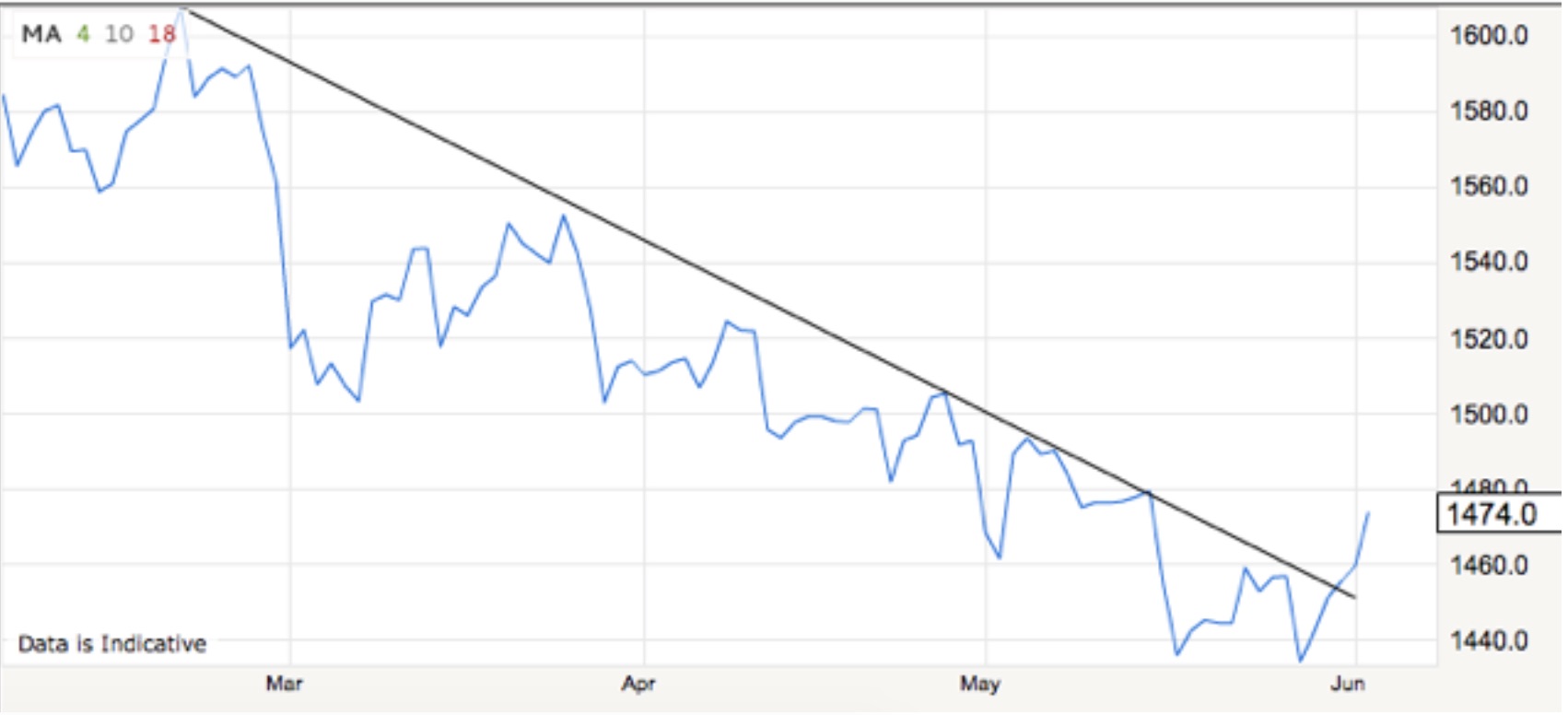
“We are finally getting the strength in gold and silver that everybody has been watching and waiting for, Eric. Both gold and silver are breaking out from their downtrends. We’ve had a couple of false starts because, until recently, $1,300 has been impenetrable. But that has changed…

Gold has now blown through $1,300. Silver is still below critical overhead resistance at $15, so we need to watch that level. If silver hurdles $15, it will be important confirmation that both metals are turning higher.

Both gold and silver are acting well today in London’s market for physical metal – not paper, the real thing. The accumulation of physical metal is actually a continuation of a major trend. So the demand for physical metal has been strong. Buyers want a tangible asset. They know that paper gold only gives them exposure to the gold price.

So you get two things by owning physical metal – exposure to the gold price and safety. There is no counterparty risk when you own physical gold, which is of growing importance given all the shaky banks around the world.

Here is a current chart of gold’s spot price in London for physical metal. It’s been a mini-rocket launch."

- Source, King World News

Friday, June 21, 2019

Bitcoin VS Gold: A Definitive Comparison

My exposition of the soundness of Money may have already alerted you to some of the attributes that have made proof-of-work cryptocurrencies such as Bitcoin nascent Moneys over such a short period of time, especially as compared to baseless fiat currencies, which took millennia to be adopted by human cooperative societies. It is true that Bitcoin has been designed to mirror the properties which have made Gold the natural Money throughout history. 

It was precisely for this reason that I found myself involved with Bitcoin so early on and why, even today, the thrust of my efforts in this paper are not advocating the idea that investors should “drop” it. The issue for me is that the Bitcoin community cannot, on the one hand, base its entire future on the Proof-of-Work argument while maligning Gold, which is the natural ideal which any proof-of-work currency strives to embody. As I shall show in the remaining sections of this paper, pursuing this flawed intellectual path introduces a necessary comparison which, unfortunately for Bitcoin, renders it inferior to not just Gold, but most corporeal units of metabolic energy made manifest in naturally scarce elements that survive through time.

Bitcoin is a paradox. On the one hand, its creation involves a proof-of-work predicated on the exertion of metabolic energy (the massive energy expenditure made in the form of the electricity used by the computers that “mine” it). On the other hand, this exertion is an effective opportunity cost for a cooperative society’s surplus of metabolic energy, which, due to the infinite demands of Bitcoin, is unsustainable through time.

The reason for this is that without the act of “mining” Bitcoins, there could be no Bitcoins. That is because the genius of Bitcoin is also its Achilles heel: its apparently decentralized properties which induce cooperation to secure a growing ledger of transactions requires that an increasing amount of metabolic energy be invested in the validation of mining blocks every few minutes. Each block serves a dual purpose of validating the latest transactions and, equally important, as the definitive ledger that tells every holder how much Bitcoin they own. This interweaving of the payment systems with the actual ledger affirming who owns what is how Bitcoin attempts to emulate Gold’s physical properties as being a measure of toil and motivator of merit, and these attempts are what contribute to its adoption as Money. Alas, as we shall soon see, this adroit design was achieved by mortgaging the future, and presents a serious issue for Bitcoin in the long-term.

The term “mining,” in this case, is really a misnomer. Instead of the word “mining,” consider the Bitcoin proof-of-work hashing and block validation as a massive, continuous investment of energy to maintain the network. Without this investment, Bitcoin (or any other cryptocurrency for that matter) is merely an abstraction—nothing more than lines of code, or, more specifically, mathematical operations that any ordinary person could simply write down with pen and paper. In contradistinction, Gold is mined because it is naturally rare and naturally immutable according to the first-order laws of nature. The act of mining does nothing to validate Gold’s continued existence just as the act of breathing does nothing to validate the existence of Oxygen. As a natural element, Gold’s inherent attributes of being extremely rare and non-reactive with air make it a perfect embodiment of metabolic energy, allowing it to serve as a measure of toil and motivator of merit in the objective present within any human cooperative society while remaining physically constant through time. In other words, the natural properties of Gold make it Money par excellence.

Mining more Gold makes more Gold available, which then circulates forever within and between human cooperative societies. There is no existential need on the part of Gold for a continued investment of energy, and the Gold, which serves as an embodiment of previously expended metabolic energy, can be worn as a ring or stored in one’s place of shelter. There is no shared ledger here, nobody can truly know how much Gold exists or is being owned at any one specific moment in time.

The point here is that Gold doesn’t need to refer to a blockchain to know what it is...it merely exists and continues to exist effortlessly and without the need for any subsequent investment of metabolic energy. Both energy and entropy are intrinsic to our existence as first order properties of the natural order. Likewise, Gold is born of the same natural mysteries, a first order property of nature, but it is, in its physical form, the only matter in nature which is immune to the forces of entropy through time—an idea I initially expounded in my 2017 essay: The Natural Order of Money and why Abstract Currencies Fail.

Bitcoin and other cryptocurrencies require us to constantly divert our collective metabolic energy and time into supporting the integrity of a mathematical abstraction. This activity is, therefore, secondary to the first order laws of nature. When a farmer produces a crop, it feeds society’s hunger. When a miner produces copper, it powers society’s energy infrastructure. 

When a wildcatter discovers oil, it propels humanity’s transportation systems. When a miner decides to take a risk and mine Gold, that opportunity cost results in additional Gold which can be used in computer chips to conduct electromagnetic energy without tarnishing or be employed as money—a lasting, objective measure for the other, more quickly decaying first order products of nature.

Based on the experience of debating this issue for over a decade, I find that this concept has been very difficult to grasp for modern economists, academics, and members of the so-called “service economy,” but the simple fact is that it is a self-evident truth.

On the other hand, I often find that primary cooperators have an easier time understanding this feature of our natural world. It is often members of the primary cooperative, such as farmers, fishermen, and miners, that recognize Gold is no different than the tomatoes or the lithium or the apples they toil so hard to produce. It is a first order manifestation of human toil and merit via direct negotiation with nature.

The secondary cooperative, the “service economy” (to use the current expression), is where Bitcoin lives. It is within this mathematical computation realm that crypto appears to be rare, appears to move around with ease, and seems to represent the realization of a long-lasting and immutable state. Alas, none of this is real. At the end of the day, Bitcoin is nothing more than a poorly conceived monetary system which taxes metabolic energy rather than preserving it—a system that simply tries to mimic what nature has already perfected and made self-evident.

If the world’s Gold miners stopped mining tomorrow, nobody that owns Gold would care. One gram of Gold would remain one gram of Gold. The Bitcoin story is different. Any owner of Bitcoin only owns what the latest version of the ledger says they own. That version exists based on the continued operation of massive computational servers somewhere out there requiring society to constantly divert its metabolic energy to maintain the apparent utility of the service.

Having laid out the foundational philosophical differences between Bitcoin and Gold, I shall now conclude my paper by providing several proofs for why Gold is superior to Bitcoin. I shall do so by employing the languages of mathematics to abstract physical phenomena from the natural world, and thermodynamic physics to convey the dynamics at the heart of the corporeal world.

- Source, Goldmoney

Sunday, June 16, 2019

Time preference and fiat money

Today’s economists do not recognise time-preference. For them, economics is about Jevon’s mathematics, state-issued currencies and the exclusion of human interest. They say we have moved on from the household economics of yester-year, and they despise classical stick-in-the-muds. But we can see from their repeated failure to tame human action in order to conform to their economic models that modern economists do not have the answers either. All they have done is cover up their failures through monetary inflation.

The ubiquity of unbacked state currencies certainly introduces new dimensions into prices and deferred settlement. Not only is the saver isolated from borrowers through bank intermediation and the belief his deposits are still his property, but his savings are debased through monetary inflation without his knowledge. The interest he expects is treated as an inconvenient cost of production, to be minimised. Interest earned is taxed as if it were the profit from a capitalist trade, and not compensation for a temporary loss of possession.

Consequently, the saver has been driven to speculate well beyond the possibility of not being repaid by a borrower by buying equities instead. He swaps credit risk for entrepreneurial risk. And because the expansion of bank credit out of thin air favours the entrepreneur over the saver, the theory goes that over time he is compensated for the loss of interest. The whole system has changed, and even consumers, who under the classical economic model would defer some of their consumption, have become unsecured borrowers themselves.

It is this evolution away from the strictures of time preference that has taken us to zero and negative interest rates. Yet, if the cost of money was simply its interest rate, the economy would be permanently mended and there would be no credit cycle. Why on earth it took the planners so long to understand the benefits of free money, and to even pay borrowers to borrow, would have been a mystery. Yet, experience and an understanding that economics is a human science tells us otherwise. Despite handing out free money, the Eurozone is in a worse economic and systemic condition than it was before the Lehman crisis ten years ago, with major bank share prices languishing at all-time lows. And all zero interest rates have achieved, together with aggressive monetary debasement, was the deferment of a banking and systemic crisis.

But credit cycles still exist. At their root is the issuance of money and credit on terms that do not reflect time preference. The value of ownership compared with the promise of future ownership has to be respected. It is not something a monetary planner can decide, because it is wholly a market phenomenon. No one but individual consumers can contribute to the collective judgments that say this any species of bird is worth more than two of them in the bush.

Ignoring time preference is the fundamental error behind monetary planning. It is why in a successful economy, monetary intervention by the state is kept to a bare minimum, or preferably banished altogether. Instead, it builds on the error of Jevon’s mathematical approach and the banishment of the people’s choice of money, which throughout history has been metallic.

- Source, Goldmoney

Wednesday, June 12, 2019

The Interest Rate Fallacy

There is a widespread assumption that interest rates represent the cost of borrowing money. In the narrow sense that it is a rate paid by a borrower, this is true. Monetary policy planners enquire no further. Central bankers then posit that if you reduce the cost of borrowing, that is to say the interest rate, demand for credit increases, and the deployment of that credit in the economy naturally leads to an increase in GDP. Every central planner dreams of consistent growth in GDP and they seek to achieve it by lowering the cost of borrowing money.

The origin of this approach is mathematical. William Stanley Jevons in his The Theory of Political Economy, first published in 1871, was one of the three discoverers of the theory of marginal utility and became convinced that mathematics was the key to linking the diverse elements of political science into a unified subject. It was therefore natural for him to treat interest rates as the symptom of supply and demand for money when it passes from one hand to another with the promise of future repayment.

Another of the discoverers of the theory of marginal utility was the Austrian, Carl Menger, who explained that prices were subjective in the minds of those involved in an exchange. He argued it was fundamentally a human choice and therefore could not be predicted mathematically. This undermines the assumption that interest is simply the cost of money, suggesting that some sort of human element is involved, separate from pure cost. Eugen von Böhm-Bawerk, who followed in Menger’s footsteps saw it from a more capitalistic point of view, that a saver’s money, which was otherwise lifeless, was able to earn a saver a supply of goods through interest earned upon it.

Böhm-Bawerk confirmed interest produced an income for the capitalist and was a cost to the borrowing entrepreneur, but agreed with his mentor there was also a time preference element, the difference in the value of possessing money today compared with the promise of possessing it at a future date. The easiest way to understand it is that savers are driven mainly by time-preference, while borrowers mainly by cost. This was why borrowers had to bid up interest rates to attract savers into lending, the explanation for Gibson’s paradox.

In those days, money was gold, and currencies were gold substitutes, that is to say they circulated backed by and freely exchangeable into gold. Gold was the agency by which producers turned the fruits of their labour into the goods and services they needed and desired. Its role was purely temporary. Temporal men valued gold as a good with the special function of being money, but as a good, its actual possession was worth more than just a claim on it in the future. But do they ascribe the same time preference to fiat currency? To find out we must explore the nature of time preference as a concept.

- Source, Goldmoney

Friday, June 7, 2019

Bitcoin makes a comeback. Here’s more on the mystery rally

Surprising many, after dragging its feet the past few months, Bitcoin suddenly surged in value by almost 100% against the US Dollar and peaked at over $8,000. Some experts have said this trend is possibly the end of the cryptocurrency bear market, while others are chalking it up to a temporary and unexplainable bullish surge.

On May 19, Bitcoin was pumped with over $18 billion in capital as a response to the unexpected increase. Bitcoin Cash, Binance Coin, and Dash were trading at 7% higher than usual and EOS, Litecoin, Stellar, IOTA, Monero, and Etherum were trading at 4% higher.

This is the second time this year that Bitcoin has made a mysterious sharp uptick since its lowest value of $3,150 in December 2018.

In April, Bitcoin briefly hovered over $5,000, an almost 20% or $950 increase in value in minutes.

James Turk, banker-turned-founder of online investment platform Goldmoney, tweeted a graph showing Bitcoin’s increase in April after a four-month low.
What is Bitcoin?

Bitcoin is a kind of cryptocurrency that has a reputation for being volatile.

The IMF explains that cryptocurrency like Bitcoin, Litecoin, and Ripple are digital currencies that can be created through cryptography and mathematics. People who want to ‘mine’ cryptocurrency have to solve complex algorithm with powerful computers and servers.

Bitcoin exists only on virtual networks. When people use Bitcoin, their transactions are recorded anonymously in a permanent digital ledger called blockchain.

Reuters says, “Blockchain works by providing a shared record of data held by a network of individual computers rather than a single party. Its supporters say this makes it hard to tamper with, thereby ensuring a secure way to track goods along with the supply chain.”

While cryptocurrency removes middlemen, is decentralised, and can be accessed through mobile apps, it is poorly regulated and risky to invest it because its value fluctuates greatly.

Coin Central says its value fluctuates as much as 20% every 48 hours. Bitcoin owners can even lose all their money if they forget the password to their digital wallets.

RBI, too, has warned against cryptocurrencies, saying their value is unpredictable. In 2018, it even issued a circular saying that the country does not recognise cryptocurrencies as legal tender.

Regardless of its volatile nature, tech companies like Facebook have been researching more into how cryptocurrency can be used. Facebook is working on developing cryptocurrency for WhatsApp in India.

The Commerce Ministry also launched a new blockchain-based e-commerce marketplace that is a pilot project for Indian coffee farmers. On this blockchain processor, Indian farmers can directly sell their produce to exporters and roasters.

France and Ethiopia also use blockchain processors for coffee sales.

Possible explanations for Bitcoin’s surge

When Bitcoin’s valued jumped in April, experts suggested that less stringent regulations in the US might be the reason.

The US Securities and Exchange Commission was reviewing applications that would create a separate exchange traded fund for Bitcoin.

New York’s Department of Financial Services also just approved Tagomi Trading LLC’s bid for a cryptocurrency trading licence, saying it wanted to give consumers more choice.

Top financial institutions, such as JPMorgan and Goldman Sachs, have also embraced cryptocurrency.

JPMorgan is launching its own cryptocurrency called JPM Coin that it will use to settle payments via a blockchain. However, JPMorgan has taken a very cautious stock of such digital currencies.

CNN reported JPMorgan’s response to the surge this week: “Over the past few days, the actual price has moved sharply over marginal cost. The divergence between actual and intrinsic values carries some echoes of the spike high in late 2017, and at the time, this divergence was resolved mostly by a reduction in actual prices.”

CNN added that people need not fall prey to JPMorgan’s “fear mongering” because the cryptocurrency is “proving to be a solid alternative investment” in the background of the trade war between the US and China, fluctuating oil prices, and lacklustre gains from gold investments.

This is probably why Bitcoin seems to be in a bullish phase, because investors are gaining confidence in the cryptocurrency and expecting its value to hold steady for a while or keep increasing.

Galaxy Digital CEO Michael Novogratz has also predicted that Bitcoin will likely hit $10,000 in the coming months and its current value is a “stall point”.

-Source, Qrius

Monday, June 3, 2019

BTC Emerging from the Clouds in Heaven Bitcoin as a Haven Asset

James Turk of Goldmoney says investors are de-risking their portfolios by pivoting away from bonds and stocks into assets like bitcoin and gold. The banking, investments, and commodities expert speaking to King World News said dovish central banks policies, a weak European banking system, and the U.S. – China trade tussle will eventually have a negative blowback on the mainstream market.

Bitcoin and Gold Lead Bullish Breakout

Both bitcoin and gold are enjoying renewed price resurgence since the start of April 2019. Gold is currently looking to break beyond the $1,300 resistance price, which would cement the bull case for the precious metal.


Bitcoin is up more than 120 percent since the beginning of 2019 and has gained more than 100 percent between April and May 2019 alone. In the last six days, the top-ranked cryptocurrency has added about $2,000 to its pricewith a market capitalization approaching $150 billion.

While gold and bitcoin are on the up, stock markets have been taking a beating. The Dow plunged 600 points on Monday (May 13, 2019) but managed to claw back 200 points the following day. However, as at the time of writing this article, fears over a trade deal failure with China has seen the Dow fall another 175 points.
Dovish Central Bank Policies Doomed to Fail

According to Turk, the main reason for the uptrend in bitcoin and gold is because investors are wary of the vulnerabilities in the banks and mainstream assets. Thus, they are moving money away from markets with counterparty risk to assets like bitcoin and gold.

With the U.S. Federal Reserve adopting a dovish approach to its monetary policy by enacting quantitative easing and slashing interest rates, other central banks have also adopted the trend. European banks, in particular, might be significantly more vulnerable to any negative blowback from this policy and may end up being unable to service bad debt further weakening the economies of many member states.

US-China Trade War

The U.S. – China trade war further exacerbates the situation as rising U.S. tariffs could see Beijing not only retaliating with increased tariffs of their own but massive dumping of U.S. Treasuries. These extenuating circumstances might be putting the market on the path of another crisis.

Many experts are espousing the belief that bitcoin’s lack of correlation with mainstream assets makes it a suitable hedge against any risks in the market. Thus, more investors may decide to safeguard their wealth in bitcoin with the situation of the global market becoming more tenuous.

- Source, BTC Manager

Friday, May 24, 2019

Golden Straws In The Wind

Life in the world of gold bullion is full of mysteries. Each mystery is like a straw in the wind, which individually means little, but tempting us to speculate there’s a greater meaning behind it all. Yes, there is a far greater game in play, taking Kipling’s aphorism to a higher level.

One of those straws is Russia’s continuing accumulation of gold reserves. Financial pundits tell us that this is to avoid being beholden to the US dollar, and undoubtedly there is truth in it. But why gold? Here, the pundits are silent. There is an answer, and that is Russia understands in principal the virtues of sound money relative to possession of another country’s paper promises. Hence, they sell dollars and buy gold.

But Russia is now going a step further. Izvestia reported the Russian Finance Ministry is considering abolition of VAT on private purchases of gold bullion.[i] We read that this could generate private Russian annual demand of between fifty and a hundred tonnes. More importantly, it paves the way for gold to circulate in Russia as money.

We should put ourselves in Russia’s shoes to find out why this may be important. Russia is the largest exporter of energy, including gas, pushing Saudi Arabia into second place. This means she is also the largest acquirer of fiat currency for energy. That’s fine if you like fiat currencies, but if you suspect them, then you either turn them into physical assets, such as infrastructure and military hardware, or gold. Russia does both.

Then there is China. China has started announcing monthly additions to her gold reserves. China is up to her neck in dollars, and the relatively minor monthly additions to her reserves really make little difference. However, the link between the gold exchanges in Moscow and Shanghai strongly suggest Russia and China are coordinating gold dealing activities.

In any event, China now dominates physical bullion markets. Deliveries (withdrawals) from the Shanghai Gold Exchange’s vaults into public hands are running at roughly two-thirds of the world’s annual mine supply. At 426 tonnes in 2017, China is the largest gold mining nation by far, and the state owns all China’s refining capacity, even taking in doré from abroad. No gold leaves this version of Hotel California.

The frequently-expressed reasoning for their gold policies is Russia and China are locked in a financial war with their largest debtor. This is not the underlying reason these nations have chosen gold as an expression of their dislike of America’s weaponization of her monetary policies. They know the difference between unbacked fiat currencies and sound money, which has been chosen by people ever since they began to use a separate commodity to intermediate in transactions.

However, it is true the Americans have weaponised the dollar, bringing an urgency to China’s and Russia’s deployment of gold. US dollars have been the world’s reserve currency for the last forty-eight years, and America, which pays for everything in costless, newly-issued dollars, now says it wants a better trade deal. It obviously assumes the dollar’s supremacy is unchallengeable and in their need for dollars China and other exporters to America will be forced to comply.

Let’s pick this apart. The US Government pays for everything in a currency which it issues at will. New dollars only gain value once they are in circulation, but the cost of production is zero, stealing their circulatory value from previously existing currency. However, the US Government is unable to balance its books without recycling some of these duff dollars into its own IOUs (Treasury stock). Because they are required to be repatriated to balance the US Treasury’s books, the US Treasury borrows them back from foreigners who might otherwise question the dollars true value. So, foreigners get a Treasury IOU eventually paid out in a currency IOU. It really is pig on pork.

So far, the foreigners have been successfully conned, though questions are beginning to be asked.

Logic suggests that the US Government getting something for nothing is as good as it gets. But President Trump thinks this is unfair, not on the Chinese and other foreigners swapping goods for ultimately worthless paper, but on America herself! He holds out for an even better deal. He demands the Chinese and others stop supplying real stuff to his people in return for his costless, dubious paper. In other words, speaking on behalf of the American People, he is now dissuading the Chinese from giving Americans something for what amounts to nothing.

Those on Planet Asia could be forgiven for looking at things rather differently. After Mao’s death and a brief period of accepting the dollar scam on the basis that demand for dollars would always ensure they could be exchanged for value, the Chinese have for a long time smelled a rat. This is why in 1983 they appointed the Peoples Bank to be in charge of liquidating dollars for gold and silver. They have gently played along with the dollar scam ever since, not wanting to be the party that exposes it for what it is.

Now it is Trump himself who has blown the whistle on the dollar. China and Russia have undoubtedly got the message from this new art of the deal. But at the heart of it is a deep, wider malaise in the fiat currency world. Understand that, and we get to the true reason why Russia and China are wary about accumulating the West’s fiat currencies. Until now, they have run with the hare and hunted with the hounds. China in particular uses fiat renminbi to drive expansion. But then if she didn’t, today’s world order would have probably collapsed in the wake of the Lehman crisis as the flaws and weaknesses of fiat currencies would have been exposed.

The next credit crisis could change everything

So far, China and Russia have resisted the temptation to act precipitously. Their economies are dependent on Western cooperation. Russia exports energy to the West, and China runs a trade surplus in goods and services. To dispense with Western trade, they need an Asia-wide self-contained market. They are building it, with China’s silk road projects and by consolidating the membership of the Shanghai Cooperation Organisation. But not all the groundwork has been done, certainly not enough to “go commando”.

The transfer from a dollar-centric world to gold-backed roubles and renminbi will continue to be at a pace determined by the monetary mistakes of America. That is why the next economic downturn is so important to geopolitical outcomes. And it won’t be just a rerun of Lehman, characterised by a sudden crisis, money-printing, and heaving a sigh of relief when the banking system doesn’t collapse.

The starting-gun for the next credit crisis has already been fired. A reversal of expanding cross-border trade is in full swing. The sales of dollars by foreigners has begun. There is little doubt there is a recession ahead, the only question is of its likely depth. The massive build-up of unsustainable global debt since the Lehman crisis tells us to expect the liquidation to be substantial. The coincidental combination of the peak of the credit cycle and trade protectionism warns us of something far worse than an ordinary recession: a possible rerun of 1929-32, only this time with unsound currency instead of currencies freely convertible into gold.

It is the sheer scale of the problem which is likely to prove the undoing of fiat currencies. A deep recession will do catastrophic damage to government finances, which can only be covered by massive monetary expansion. At the same time, monetary policy is designed to ensure the general price level does not fall. This occurs when a credit crisis wipes out demand, and prices in sound money fall significantly. We know this because in 1929-32 measured in gold-backed dollars prices did just that.

It may take a few months before the purchasing power of fiat currencies begins a renewed decline. The recent strength in energy and commodity prices is worrying in this context, but it is probably too early to call it the start of a definite trend of falling purchasing powers for the dollar and other currencies, measured against the commodity complex.

Trouble is likely to start with either the dollar or the euro. In a deepening recession, the euro will struggle with escalating problems in the PIGS[ii], Brexit, US trade protectionism and systemic risks in the Eurozone’s banking system. The Eurozone could easily disintegrate. A falling dollar, over-owned in the context of declining international trade, is also a racing certainty. A race to the bottom for both currencies is becoming the increasingly obvious outcome of a slump in world trade.

Politicians are ill-equipped for a monetary crisis

Inevitably, the corruption emanating from the issuance at will of costless fiat currency leads to a deteriorating political morality. By debasing the currency, you can rob people of their wealth and earnings without their knowledge or approval. Get away with that, and the political class is on the highway to the ultimate in corruption.

In modern democracies, this is why the source of political power increasingly lies in the deception of the public, and why both control and debasement of a currency is its ultimate expression. The true purpose of the debasement of the currency is very rarely understood by a trusting public. The existence of a state-issued currency is blandly accepted as proof of its value, and no further questions are asked. The long-term decline in its value is given credibility by being declared to be official monetary policy, so everyone thinks it is a good thing. But the public are wholly unaware of the transfer of wealth from them to the state and its cronies, which is the inevitable consequence of monetary debasement.

It is anti-capitalistic in its destruction of both capital and values. The political class has been progressively leeching off the productive side of the economy to pay for its socialising schemes and for the sheer enjoyment of power. If the rate of currency debasement is slow and even, it can continue for a long time. As a destructive process, it is ultimately finite. But the pace has quickened. The Lehman crisis led to a rapid acceleration of the rate of currency debasement, which never really ceased. Debasement is about to accelerate yet again. Not only will the issuance of central bank money substantially increase to compensate for a slowing down in the rate of bank credit expansion, it is also becoming essential to finance government spending.

The likely scale of a renewed debasement of the currency threatens to alert the public to the instability of the situation, undermining confidence in unbacked currencies. Despite the stated intentions of monetary policy, its true purpose will become increasingly obvious when government revenue collapses and welfare costs rise. How convenient it will be for scaled-up quantitative easing, the printing of money to pay for government debt, to be slavishly supported by all advisors and commentators pretending to be economists. Wiser counsel, if it is listened to, will caution against the trap of relying on the destruction of currency values as the bedrock for future government finances.

What then for our politicians, who have come to rely on monetary debasement to finance their ambitions? Will they wake up to the predicament they have put us all in, and suddenly realise they must humbly genuflect at the altar of contrition, of sound money, and confess to their sins and submit themselves to public opprobrium?

Dream on, folks! They will struggle to extricate themselves with the only means at their disposal. More money. More socialism. More raping the productive economy by accelerating wealth transfer through monetary debasement. They know nothing else. They have not only deceived their voting public, but they have deceived themselves. If the world moves only half-way to a 1930s depression, the rate of monetary expansion to bridge the widening chasm between tax receipts and welfare obligations will be so great, it will likely lead to the end of the dollar, the end of the euro and the other currencies which copy them. Even the hitherto Teflon yen will be threatened with immolation.

The wise heads in China foresaw this in the last century, which is why they appointed the Peoples Bank to handle the state’s gold and silver purchases under government instruction. It is why they set up the Shanghai Gold Exchange in 2002 to allow and encourage the population to accumulate physical gold. They knew that one day, gold and silver would become the backbone of currencies again and they have ensured it is widely distributed. They knew the West’s Achilles’ heel was the modern equivalent of Genghis Khan’s mulberry-leaf paper, but without the great man’s despotic authority. In her long history, China has been there, seen it, done it, and has got the changshan.

Russia was late to this party, but the transformation in her understanding of the West’s monetary affairs was swift. America tried to use the dollar as a weapon to cripple Russia, but President Putin wasn’t to be panicked. He appointed a bright young woman, Elvira Nabiullina to head up the Central Bank of Russia. She reformed the banking system, strengthening commercial banks and replaced the Brussels-based SWIFT interbank messaging system with its own, which will link up with the Central Asian ‘stans, China, Iran and even Turkey. This will insulate Russia from Western banking crises, a point missed by Western commentators who only see isolationism. And it is Nabiullina who has overseen the selling of dollar reserves for gold bullion.

Russia and China have distanced themselves from the west’s financial system, so it can collapse without taking them down. Obviously, there will be collateral damage, but nothing unforeseen. They will be aware of the political consequences, so will not want to precipitate anything with their actions. Let the West destroy itself and for China and Russia not to be made the fall-guys.

- Source, James Turks Goldmoney, read more here