buy gold and silver bullion

Tuesday, April 28, 2020

The Looming Gold Derivative Crisis

One of the scares at the time of the Lehman crisis was that insolvent counterparties risked collapsing the whole over-the-counter derivative complex. It was for this reason that AIG, a non-bank originator of many derivative contracts, had to be bailed out by the Fed. By a mixture of good judgement and fortune a derivative crisis was averted, and by consolidating some of the outstanding positions, the gross value of OTC derivatives was subsequently reduced.

According to the Bank for International Settlements, in mid-June last year all global OTC contracts outstanding were still unimaginably large at $640 trillion, a massive sum in anyone’s book. It is unlikely to have changed much by today. But in bank balance sheets only a net figure is usually shown, and you have to search the notes to financial statements to find evidence of gross exposure. It is the gross that matters, because each contract bears counterparty risk, sometimes involving several parties, and derivative payment failures could make the payment failures now evident in disrupted industrial supply chains look like small beer.

Deutsche Bank’s 2019 balance sheet gives us an excellent example of how they are accounted for in commercial banks. It conceals derivative exposure under the headings “Trading assets” and “Trading liabilities” on the balance sheet. You have to go into the notes to discover that under Trading assets, derivative financial instruments total €80.848bn, and under Trading liabilities, derivative financial instruments total €81.910bn, a difference of €1.062bn This is relatively trivial for a bank with a balance sheet of €777bn.

But wait, there is another table that breaks derivative exposure down even further into categories, and it turns out the earlier figures are consolidated totals. The true total of OTC derivatives and exchange traded derivatives to which the bank is exposed is €37.121 trillion. That is nearly thirty-five thousand times the €1.062bn netted difference in the balance sheet. And when you bear in mind that valuing OTC derivatives is somewhat subjective, or as the cynics say, mark to myth, it invalidates the valuation exercise.

Clearly, by taking the mildest of a positive approach to derivatives held as assets, and a slightly more conservative approach to valuing derivatives on the liabilities side, that 35,000:1 leverage at the balance sheet level can make an enormous difference.

Now let us take our imagination a little further. A large number of these derivatives will have commercial entities as counterparties, businesses that have been shut down by the coronavirus since the balance sheet date. With the German economy already heading into recession before the coronavirus closed down much of the global economy, Deutsche Bank’s risk of losses arising from its derivative position could turn out to be in the trillions, not the one billion netted difference shown on the balance sheet.

Not only is there the emergence of counterparty failures to deal with, but there are ever-changing fair values, which will particularly reflect interest rate spreads increasing for Deutsche Bank’s €30.25 trillion interest rate-linked derivatives. We cannot know whether it is net positive or negative for shareholders. And with balance sheet gearing of assets 22 times larger than share capital very little change could wipe them out.

Deutsche Bank is not alone in presenting derivative risk in this manner: it is the elephant in many bank boardrooms. As a weak link, Deutsche is a relevant illustration of risks in the banking system. Since the Lehman crisis, its senior management has been on the back foot, retreating from businesses they could neither control nor understand. They have also made very public mistakes in precious metals, which is our next topic.
Gold derivatives in crisis

While a struggling bank like Deutsche provides us with a laboratory experiment for how a derivative virus can kill a bank, we are now seeing it kill off bullion banks in real time. A rising gold price, out of the control normally imposed by expandable derivatives, has effectively gone bid only in any size. We are told this is due to COVID-19 shutting mines and refineries and disrupting logistics, and so is purely temporary. The LBMA and CME which runs Comex have been issuing calming statements and even announced the introduction of a new 400-ounce gold futures contract alleged to ease the supply shortage.

In short, the gold derivative establishment is panicking. The swaps position on Comex shows why.


With their net short position in very dangerous territory, Comex swaps are badly wrongfooted at a time when the Fed and other central banks have announced unlimited monetary inflation, signalling a paradigm shift in the relationship between sound and unsound money. For ease of reference and to understand their relevance, a swap dealer is defined by the Commodity Futures Trading Commission, which collates the figures, as follows:

An entity that deals primarily in swaps for a commodity and uses the futures markets to manage or hedge risks associated with those swap transactions. The swap dealer’s counterparties may be speculative traders, like hedge funds, or traditional commercial clients that are managing risk arising from their dealings in the physical commodity.

Therefore, a swap dealer is one that operates across derivative markets, and typically will trade in London forwards as well as on Comex. In a nutshell, it describes a bullion bank’s trading desk.

In a further piece of disinformation this week, Jeff Christian, head of CPM Group, in an obviously staged interview for MacroVoices claimed that traders in London were forced by their banks to cover trading risk in the futures market as a condition of their funding. The implication was shorts on Comex are matched to longs in London’s forward market and therefore not a problem. This may be true of an independent trader looking for arbitrage opportunities between markets but is not how it works in a bank.

- Source, Goldmoney

Friday, April 24, 2020

Enter the Coronavirus Crisis, Banks to Be Overwhelmed With Debt Defaults

We have made the important point that before the coronavirus lockdown, the credit cycle was already turning down. Liquidity strains had surfaced last September, with the Fed routinely supplying tens of billions of dollars of liquidity through the repo market.


The monetary base, which represents the quantity of money in public circulation created by the Fed, is now growing at the fastest pace on record. But since January, a new problem arose: the disruption to production supply chains from the virtual shutdown of Chinese production due to the coronavirus.

The manufacture of anything requires multiple inputs, commonly referred to as supply chains. The concept of a supply chain suggests they are one dimensional: a series of production steps that go towards a single product. This is not the case. Supply chains are multidimensional and involve supplies from many sources in many jurisdictions at every production stage. The sequential shutdown of China, South Korea and much of South East Asia was followed by Europe, Britain and America. During these shutdowns almost all production and sales of non-food goods and non-essentials ceased.

While the assembly of a product progresses in one direction, payments flow backwards down the chain as each production step is delivered. The sum of the payments involved is far greater than the value of the final product. The global payment disruption is therefore significantly greater than the GDP number, which only consists of the sum total of final products bought by consumers. In the case of the US, an approximation of domestic payment disruption is contained in the gross output statistic, which is $38 trillion compared with a GDP of $21 trillion.

The US economy is significantly services-driven, with shorter supply chains on average than an equivalent manufacturing-based economy, such as China or Germany. If you add together supply chain payments abroad that feed into final goods sold in America, total payments for intermediate production stages in dollar-driven production probably add up to more than $50 trillion, the majority of which are now frozen.

To understand the impact of this new factor on bank credit, we must divide business customers into two classes; those with cash and those that depend on bank loans for working capital.

Both categories have establishment and other costs that continue despite the collapse in production. Those with cash liquidity draw it down to make payments, reducing bank deposits, which are recycled into other deposits which may or may not be with the same bank. When those deposits reduce existing overdrafts, bank credit contracts reflecting a loan repayment. When they amount to a simple transfer of deposit ownership, they do not.

The greater problem is with businesses that need loan cover for missed payments. There are so many of them with payment failures, bankers are being overwhelmed. Whether they realise it or not, they cannot afford to say no to demands for credit because Irving Fisher’s debt deflation problem is so urgent that to deny loan requests would likely end up wiping out the banks’ own shareholders’ capital and then some.

Supply chain payment failures are becoming a banking problem many times larger than the banking cohort shareholders’ capital. The ratio of US gross output to total equity capital for commercial banks in the US is nineteen times. In other words, unless the Fed can increase base money by at least that and somewhat more to compensate for a degree of bank credit contraction, the economy and the banking system will almost certainly crash.

In Germany, where the two major private banks shown in Figure 3 have balance sheet to equity ratios of 15.1 and 22.6, supply chain disruptions seem certain to lumber them with a fatal combination of dramatically widening commercial bond spreads and payment failures from the mittelstand.

Everywhere else, the problem is the same. The Fed has responded by reducing the cost of drawing down established central bank liquidity swaps lines, but they were only available to the ECB, the Bank of Japan, The Bank of England, Bank of Canada and the Swiss National Bank. Recognising the wider problem, on 19 March the Fed extended swap lines temporarily to the central banks of Korea, Australia, Brazil, Denmark, Mexico, New Zealand, Norway, Singapore and Sweden for six months. A notable absentee from the list is China, which one would have thought is the most important user of dollar liquidity based on trade. Politics trumps the delivery of monetary policy in defiance of the scale and urgency of the crisis.

The problems facing the whole banking system have never been greater. Individually, commercial banks are bound to take every opportunity to reduce their risk exposure before the market values of collateral, particularly equities, corporate debt and both residential and commercial property categories fall further in value. Banks will attempt to reduce their interbank exposure, particularly to European banks. Eurozone banks are likely to be the first to fail, needing state bail outs. Counterparty risk in over-the-counter derivatives becomes a major concern for all. And central banks are on a wing and a prayer if they think commercial banks will simply ensure liquidity gets to the right places in time to prevent a financial crisis.

- Source, James Turks Goldmoney

Monday, April 20, 2020

The Destructive Force of Bank Credit

Never has it been more important to understand the psychology and motivation behind changes in the level of bank credit at a time when governments and central banks are relying on commercial banks to transmit Keynesian stimuli to distressed borrowers. And never has it been more important for analysts to differentiate between deflationary forces that come entirely from the contraction of bank credit and inflationary forces that arise from central banks’ monetary policy.

Whether policies to rescue economies from the financial and economic effects of the coronavirus will actually get to the intended businesses depends largely on the transmission mechanisms for base money. While special powers for direct funding of large corporations may be implemented and the extension of public ownership to prevent bankruptcies of large players is very likely, commercial banks will be expected to play a central role in distributing monetary stimuli to businesses of all sizes. But since they regard small and medium size businesses as either too risky or not worth bothering with, it will be a struggle to get them to deliver the financial support intended.[i]

In any advanced economy, a Pareto 80% of GDP is provided by small and medium-size enterprises. In a highly centralised banking system, for the banks that have access to the Fed through prime broker subsidiaries, SMEs are simply not worth bothering with. It leaves the majority of enterprises providing goods and services to the public out in the cold. Bankers looking through the dip will want to preserve more profitable relationships with large corporations and reduce their exposure to risky, expensive-to-administer smaller loans.

Despite the central banks’ generous intentions, the majority of businesses that rely on bank lending for working capital will therefore find finance frozen by bankers now driven by fear of risk instead of grasping lending opportunities underwritten by government support. Businesses with cash will learn that they are taxed by the debauchment of their money to subsidise failing competitors.

Investors who are used to getting positive returns solely on the back of expansionary monetary policies are now egging on the authorities to spend, spend and spend one more time. Penson funds and insurance companies in particular will now discover they are being lumbered with the cost of monetary expansion by an increasing depreciation of the currency, which escalates future liabilities. Ever since the investment industry pandered to the inflationary policies of central banks this outcome was inevitable, because both logic and sound economic theory tell us you cannot continually inflate your way out of trouble.

That end point is where we have now arrived. The state has come to rely completely on inflationary stimulation. The helicopters have warmed up and are ready to distribute monetary largess created by the magic of central banking, not just to individuals, but to their employers as well.

Mission impossible is to restore economic activity to where it was before the coronavirus shutdown. Politicians assume is can be achieved by deploying military precision. They have taken for themselves a mandate to sweep aside all bureaucracy and all objections to the role of the state. All it requires is for the banks as well as other critical actors to submit to their authority.
The credit cycle was turning down before the virus hit

It ignores the impact of the credit cycle, which was already turning down in the second half of last year. In response, the Fed first stalled its attempt to restore its balance sheet to normality and from September onwards was forced to publicly intervene to inject massive amounts of liquidity into the banking system through the repo market.

All was not well in wholesale dollar markets at least five months before the virus hit, so the problem is more complex than a simple return to normality when the virus passes. Furthermore, the authorities trying to keep the economy from imploding are out of their depth, so much so that individuals in the private sector are gradually realising it as well. Financial risk has escalated considerably, which has one effect: bankers will use every opportunity to reduce the size of their balance sheets. The authorities will struggle to get banks to hold fast, let alone distribute subsidies to producers and consumers alike.

Attempts at rescuing the global economy and supporting financial asset values upon which bank collateral is based will require massive inflation of base money, as outlined later in this article. But these attempts will have to fight bankers trying to control their lending risk in order to protect their shareholders’ capital from being wiped out. Their motivation to deflate bank credit will be greater than ever before.

An appreciation of the deflationary implications of the current phase of the credit cycle requires an understanding of how bank credit fluctuates and the predominantly psychological factors that drive it.
The origins of bank credit

The general public is not aware that there are two separate sources of money. The central banks are empowered to issue money, but commercial banks do so as well. One way they do this is by taking in deposits and then lending them to borrowers for an interest rate turn. When the borrower draws down the loan to make payments, more deposits are created as the payments are made.

A second course of money creation is simply by lending money into existence. In this case, the loan is created first, and as it is drawn down, deposits are created. This is regarded as the more usual practice, hence the description of the process being the expansion of bank credit. Any imbalances that arise between banks are resolved through the interbank market.

By these means a bank’s own capital becomes a fraction of the bank’s expanded liabilities, hence the term fractional reserve banking. Figure 1 shows the barebones of fractional reserve banking, with a bank’s balance sheet measured in monetary units (mu), early in a phase of credit expansion.


This balance sheet reflects a cautious approach to bank lending. Shareholders’ equity is valued at one third of customers’ deposits and is covered twice by government bonds, which will all be less than five years to maturity and is regarded in the banking system as the risk-free investment standard. At this stage of the credit cycle and with the banking community generally risk-averse, lending margins are profitable. The ratio of total assets to shareholders’ equity is five times. Put another way, profits and losses from changes in asset values are multiplied five times at the shareholder level.

Figure 2 shows the same bank’s balance sheet towards the end of the expansion phase of the credit cycle.


The economy has responded to both monetary stimulation from the government’s deficit spending and interest rate suppression by the central bank. The cohort of bankers has seen a lessening of lending risk and has responded by actively seeking lending opportunities among large corporations. Bankers are now lending increasingly to medium size corporations as well as investment grade rated borrowers where the margins are better. Falling unemployment and growing economic confidence decreases lending risk for credit card and other consumer debt, and the bank has extended additional credit for creditworthy customers. Liquidity from government bonds and bills has been drawn down in order to increase allocation to higher-yielding corporate debt. The balance sheet has expanded to give an overall gearing on shareholders’ equity of 12.5 to 1.

This means a two per cent margin averaged across total assets yields a 25% profit on share capital. But by the time this snapshot is taken, competition from other banks will have likely reduced lending margins generally, and the bank has responded by taking an even more aggressive lending stance, so lending margins overall are likely to be less generous than at the start of the credit cycle and loan quality will have deteriorated.

While shareholders are enjoying excellent returns, it has become a highly risky situation for the bank. The slightest pause in the economic outlook, whether it be from interest rates being raised by the central bank attempting to control the boom, or perhaps an exogenous factor, such as trade tariffs being raised between the bank’s jurisdiction and a major trading partner, will cause the directors of our bank to switch from greed to fear in a heartbeat. In our example, all it takes is losses of 12.5% of the bank’s assets to wipe out shareholders’ equity.

If one bank suspects there may be a deterioration in trade conditions, it is certain that others will as well, because they have similar business information. Due to the dangers of balance sheet gearing, bankers are exceedingly prone to groupthink.

When it happens, the switch from greed to fear travels like wildfire. But some banks are likely to be caught out, having been aggressive lenders trying to increase the size of their bank, often with a chief executive on an ego trip. Fred Goodwin at Royal Bank of Scotland was a recent example. Ignoring all signs of the ending of a cycle of credit expansion, Goodwin pushed through a consortium takeover of ABN-AMRO in October 2007, with RBS’s portion funded by debt. The bank’s balance sheet gearing became twenty-four to one.

With gearing of that sort very little needs to go wrong to wipe out shareholders equity, which is what happened. Failures of this type are an acute risk when the banking cohort has been lulled into a false sense of lending risk by a prolonged period of business stability combining with the siren’s beckoning of a financial bubble.

Reducing bank balance sheets without creating economic instability is virtually impossible. Driven by their groupthink, frightened bankers will seek to reverse credit expansion all at the same time. They sell corporate bonds in a market with no buyers. Spreads, the difference in yield between government bonds and riskier corporate debt, blow out, catastrophic for book values. Business and personal loan facilities are capped and withdrawn, driving many companies into the hands of insolvency practitioners. It can become a race between bankers to reduce the size of their balance sheets before their competitors, as the rapid withdrawal of bank credit triggers bankruptcies and unemployment. It has happened repeatedly for the last two hundred years.

The economic effect was summed up by economist Irving Fisher in the 1930s, who is forever associated with the theory of debt deflation. As the oxygen of credit is withdrawn, businesses get into trouble and banks begin to liquidate collateral. Liquidation of collateral drives their values even lower, exposing additional formally secured lending as no longer secured. Further collateral sales follow, driving collateral values down even further. And so on.

That was in the depression years, and Fisher’s point was to link the collapse of businesses, asset values and also the failure of banks themselves with the contraction of bank credit. Subsequently, central bank policy has focused on trying to anticipate and stop the deflation of bank credit in the first place, always ready to turn on the money spigot. The government then subsidises the economy by increasing its spending without raising taxes. By using the stimulus of unfunded government spending and central bank money creation, the government and its central bank are following the Keynesian economic playbook, which now sets the relationship between the state and private sectors.

Despite everything attempted by statist intervention, we still have periodic bouts of bank credit deflation. But matters have evolved from the simple model illustrated in Figures 1 and 2 above. Banking has become highly regulated, and banks now lend on a formulaic basis, set globally by the Basel Committee (we are on rules version 3) and by local regulators.

Earlier versions of these controls permitted Fred Goodwin to take the RBS balance sheet gearing to credit hyperspace. They say lessons were learned, but the only lessons learned by the regulators were new ways to keep their eyes shut and ears plugged. Stress testing of bank balance sheets assumes little more than a moderate recession and denies the likely consequences of anything worse. The economic crisis starts with a change in banking cohort groupthink, and not, as regulators with their useless stress tests assume, a decline in GDP, a rise in unemployment, a rise in price inflation, or Heaven forfend, an unexpected financial crisis. And if you think extreme bank leverage would have been controlled following the Fred Goodwin episode, think again. Figure 3 shows current balance sheet to equity ratios for a selection of major banks. Through the magic of modern accounting practice, they are almost certainly higher than reported.


From the few examples in Figure 3 we can anticipate bank failures to originate in Europe in the event of a general contraction of bank credit. Despite reducing its balance sheet significantly in recent years, Deutsche Bank is in Fred Goodwin territory, closely followed by BNP and Barclays. And the credit cycle has very obviously turned down again. The regulators persist in behaving like the three wise monkeys, wholly unaware there is a credit cycle and what these ratios indicate.

The large American banks are not so heavily geared, but that will not protect them from the global credit contraction that will now intensify...

- Source, James Turks Goldmoney

Tuesday, April 14, 2020

Gold Starting A Historic Rise, Huge Gains to Come


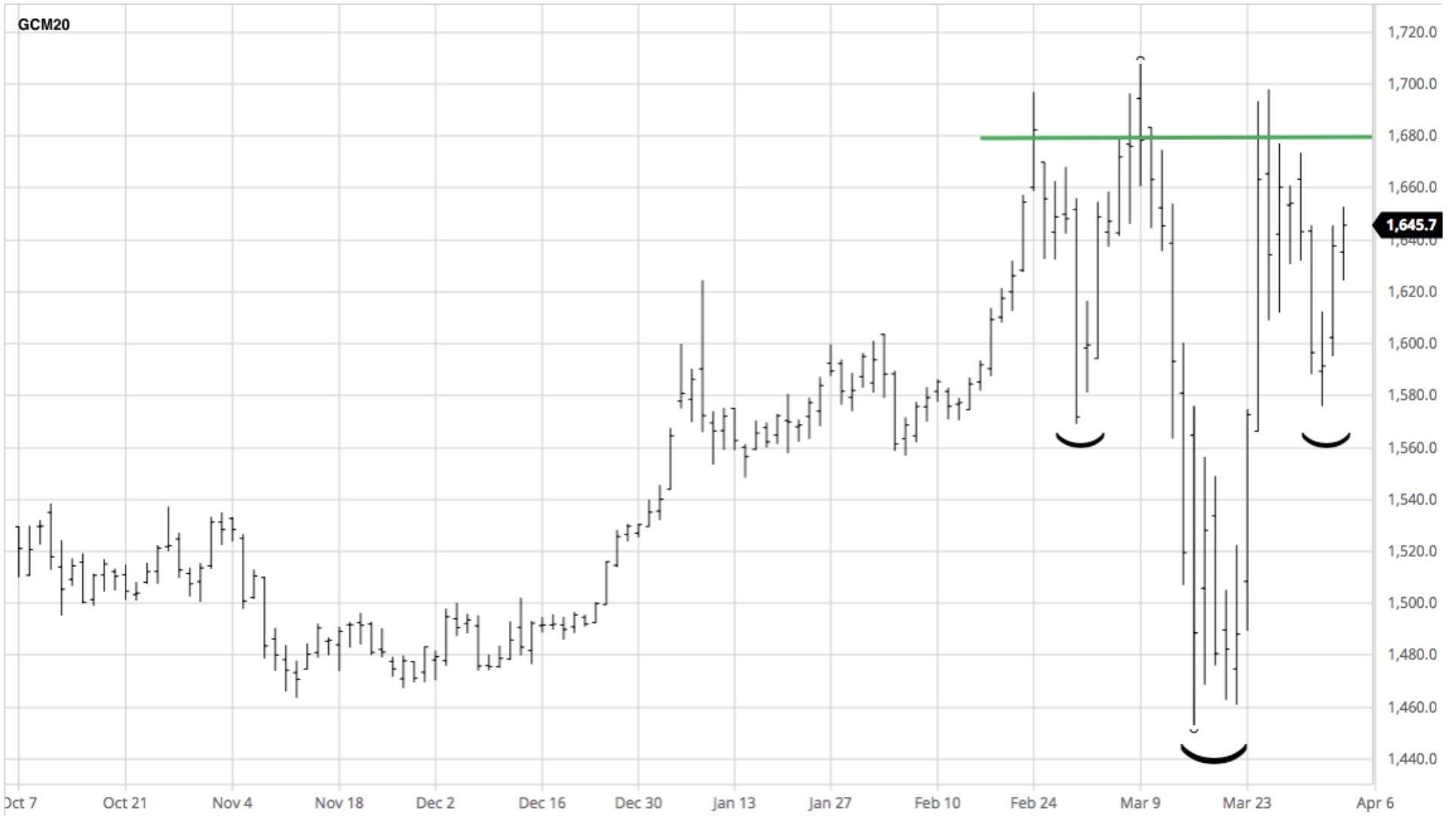
"Looking again at the chart pattern, at the moment the right shoulder is being formed. Again the price movement captured in this chart reflects what’s happening with investor psychology. 

As I mentioned earlier, the forced margin selling has ended. Gold has not made a new low and is starting to rise.

Now that investors once again have liquidity in the form of US dollars and other fiat currency, they are asking themselves what is safer: Physical gold with its 5000-year track record? 

Or fiat currency that is likely to see an accelerated rate of debasement in the months immediately ahead? Owning physical gold and silver in my view is the safer alternative.”

- Source, King World News

Thursday, April 9, 2020

James Turk: Gold Should Hurdle $1700 In Days, But This Will Be The Big Surprise

“This chart of Jun’20 gold futures is powerful, Eric. It’s the chart I mentioned in our KWN interview that you just posted on the weekend. 

My experience has been that head-and-shoulder patterns are usually reliable. The chart pattern is not yet complete. That won’t happen until gold hurdles above the neckline around $1680 or so.

Reverse Head & Shoulders Pattern On Gold
Points To A Massive Rally


The Big Surprise

Nevertheless, though incomplete the pattern now being formed is communicating a clear message. Gold is forming a huge base of accumulation, and bases like these result in higher prices, which signals the margin liquidation in the gold market has ended. 

Looks like it should only be days before gold hurdles $1700. But the big surprise for investors will be that when this happens the gold market will see new record highs above $1910 very quickly…

The head is usually formed at a selling climax, and we just went through one of those. 

The recent low in the gold price was reached as a result of liquidation and forced margin selling as a consequence of too much debt in our world’s over-leveraged financial system. 

The low in the gold price was not the result of any deficiency or problem with gold. Gold is still a safe haven because physical gold does not have counter party risk.

- Source, King World News

Monday, April 6, 2020

James Turk On The Next Bubble To Burst And Free Market Gold

“Free market (governments call it ‘black market’) is taking control of gold, just like after the March 1968 collapse of the central bank cartel called the London Gold Pool. CBs quoted an official price below real price. Fed still books its gold at the ‘official’ price of $42.22/oz.

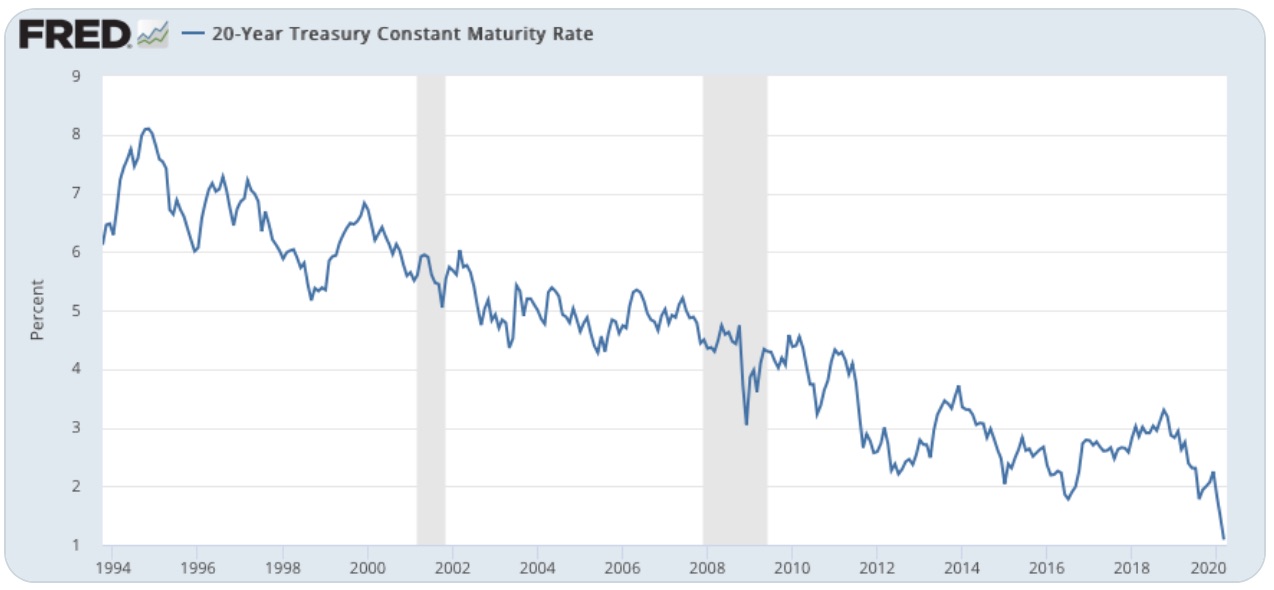
All price trends eventually end and record low yield on Treasury Bonds could be the next bubble to burst. Printing by Fed has so far kept US gov’t liquid and appearing solvent but something has to give. Higher yields seem inevitable if there is any pretense to preserve US dollar purchasing power."


- Source, King World News

Monday, March 30, 2020

James Turk: The Path Towards Fiat Money Destruction


In this interview with James Turk I ask him about Gold as Money and why gold is not an investment. 

The distinction between money and currencies. 

The path of fiat money destruction and the loss of its purchasing power. 

Why the currency and the financial system are flawed. 

What is payment risk? Governments printing money and its consequences. 

Silver versus gold and James views on both Mene a new product from Gold Money. 

What is it and why you need to know. Physical gold and counter party risk.

Sunday, March 22, 2020

Why a Bear |Market will Lead to a Dollar Collapse

The cumulative effect of central bank intervention has led to bond prices that have come badly adrift from reality. Taking a more realistic estimate of the dollar’s purchasing power than that implied in goal-sought CPI numbers, plus an estimated amount for the time preference involved, ten-year US Treasuries should yield closer to 10% to maturity, not the 1.31% implied today. If a ten-year bond has a coupon such that it is currently priced at par, the price should halve.

Those who put our monetary misfortunes down to the coronavirus have missed the point. Yes, it will be fatal, both economically and unfortunately for some of us as individuals as well. It is early days in what is definitely becoming a pandemic, that is to say an epidemic that is not restricted to national boundaries. Not only China, but other nations as well are going into a state of lock-down. Hopes that things will return to normal in the second half of this year are obviously based on a belief that there is nothing else wrong in the global economy.

This is where those who actually understand money and the credit cycle part from the economic establishment, which continuously demonstrates its cluelessness. Note these indisputable facts:

1. Economic destabilisation arises from a cycle of bank credit expansion always followed by a credit crisis. It does not arise from business, but from time to time the willingness of banks to expand credit out of thin air, creating a temporary period of economic optimism which does not last.

2. The expansion of the global money quantity since 2008 has been unprecedented, not only numerically, but in proportion to the size of underlying economies. If nothing else, logic suggests the bust that follows will be proportionately destructive.

3. While their relative magnitudes to each other were different ninety years ago, a combination of trade tariffs and the top of the credit cycle mirrors the conditions that led to the Wall Street crash between 1929 and 1932. That should be warning enough that even without a coronavirus pandemic the world is on the edge of not just a recession, but a vicious slump.

The most important difference between the Wall Street crash and the depression that followed is found in the money. In those days, both the US and UK currencies were on a gold standard, which meant that collapsing commodity prices through the dollar and sterling were effectively being measured against gold. Other factors, such as the rapid mechanisation of farming and the productivity that followed exacerbated the situation for farmers worldwide, until the UK abandoned gold in 1932 and the dollar was devalued the in 1934. In short, the link with gold meant that leading currencies were not undermined by the depression.

Nevertheless, economists in the 1930s blamed the depression on gold, and governments have sought to remove it from the monetary system. Since 1971 there has been no residual link between gold and the dollar and therefore all other state-issued currencies. The quantity of money in circulation has been free to be expanded by central banks, the only limit being the consequential limitation of price inflation. That has now been conquered by statistical method.

From their actions following the Lehman crisis it is clear central banks now feel no constraint on the expansion of the money quantity as a policy tool. The Fed, the ECB and the Bank of Japan are already expanding base money before the crisis stage of the credit cycle has materialised, which should alert us to the catastrophic failure of monetary policy. Keynes’s concept of reviving animal spirits with a kick-start of inflation has morphed into a continual and accelerating monetary inflation over the whole cycle.

Collectively, in the post-war years we all bought into monetary inflation by shifting investment allocation progressively from bonds into equities to protect long term savings. But since the interest rate spike in the early 1980s, bond yields have generally declined to the point where in dollars, euros and yen they yield less than their values of time preference. In the two latter cases investors are now even paying for the privilege of lending money to their governments.

The abolition of meaningful yields has been achieved through a combination of statistical suppression of price inflation and monetary expansion. But this is just the start of it. Imagine for a moment a collapse today akin to the 1929-32 Wall Street crash, followed by an economic slump on a 1930s scale. Freed from apparent restrictions on the expansion of money and having a mandate to do whatever it takes, combined with demands for the financing of soaring government budget deficits the expansion of money will go into hyperdrive – everywhere at the same time.

Not only do we have that problem, but we now have a viral pandemic that has all but shut down the largest manufacturing economy in the world, disrupting the overwhelming majority of supply chains elsewhere. And that assumes the coronavirus is contained to China and that early signs of it turning into a global pandemic turn out to be false. But the signs are that it is becoming a pandemic on the eve of Wall Street crash Mark II, bringing forward and amplifying the economic destruction that always follows a period of credit expansion. The effect of the virus threatens to turn an economic slump, perhaps a once in a century event, into an outright production and consumption collapse.

What lies before us will be radically different from the past. Understanding money and the effects of changes in it as a circulating medium have rarely been more important. This article outlines the effects of what lies ahead, likely to commence in a collapse of financial asset values and the purchasing power of currencies.

- Source, Goldmoney

Wednesday, March 18, 2020

The Euro: Can it Survive?

A dusty concept called the regression theorem suggests the most fragile of the major currencies is the euro. This states that in the users’ collective mind its validity as money is derived through experience. The fact it was money yesterday, and in the days, weeks, months and years in the past confirms its status: the longer the better. For the fiat currencies with the longest history, their status as money was derived from their role as a gold substitute, linking their credibility to sound money in the distant past.

In the euro’s case, it derived its original status from the fiat currencies it replaced and is only twenty-one years old. In a generally stable economic and monetary situation the lack of a longer history of regression may not matter, but it could be more easily destabilised than a more established currency at a time of crisis. Despite the Lehman catastrophe, the subsequent banking crisis in Europe and negative interest rates, the euro has so far survived intact.

The fact it has done so is in large measure due to the lack of any alternative for the 340 million eurozone residents. Perhaps its survivability has been enhanced by the convenience of non-cash transactions. In any event, a population mandated to use a state issued currency finds it is in its interests to accept its validity as a circulating medium and only abandons it as a last resort. It is when approaching that point that the regression theorem will matter.

That is a consideration for domestic users of the euro. Meanwhile, foreigners have voted with their feet, driving the rate down in recent years from $1.60 in 2008 to $1.05 in 2016, and from $1.24 in 2018 to $108 recently. It has been the principal counterpart to a rising dollar expressed in the latter’s trade weighted index. Behind these moves there is the net effect of trade balances and speculative flows.

In 2019 the Eurozone’s balance of trade was a positive $175bn, while the US trade deficit was $667bn. The sharp difference between the two economies represented a strong headwind in favour of the euro and against the dollar, but since 2018 it was more than overcome by the pull of interest rate differences. While the ECB maintained a negative deposit rate, US-based hedge funds through the fx swap market shorted the euro and bought dollars to benefit from interest rate differentials.

Since April 2018, when it became clear that President Trump’s tax policies would stimulate the US economy the fx swap trade was on. There can be no knowing the true size of it, but it was significant enough to force the Fed to intervene in the repo market to provide extra liquidity from last September to this day.

The Fed has now reduced its funds rate by fifty basis points to 1.0-1.5% and the 13-week T-bill is leading the way to yet lower yields by yielding only 0.675%. Given that prime brokers fund their inventory at the fed funds rate, they are still losing money, so the Fed will be forced to lower the FFR again to 0.5%-0.75% to avoid disrupting the T-bill market. Even that assumes no further fall in T-bill discounts, but it does mean that interest differentials between dollars and euros will fall again, with consequences.

The declining profitability of fx swaps out of both euros and Japanese yen and into dollars plus increasing liquidity and counterparty risks means hedge funds should be aggressively unwinding their positions. Already, in recent days we have seen the yen rise from 112 to the dollar to 106.9 (note that a decline in the rate signals a stronger yen). And the euro against the dollar has gone from under 1.08 to 1.1175. The effect on the dollar’s trade weighted index has been dramatic, as shown in Figure 1 below.


The start of the fx swap trade for hedge funds is highlighted by the solid arrow, when in April 2018 it became clear that President Trump’s fiscal policies would lead to higher dollar rates and bond yields relative to both those of the euro and the yen, but particularly against the euro due to the index’s weighting in favour of it. While the bull market persisted, for most of the time it has been in the form of a weak broadening top delineated by the pecked lines. It is in this context we can see the impact of the coronavirus on dollar exchange rates, with the TWI suddenly falling by about 2½%. If it breaches 96.5, we will have technical confirmation the dollar is due to fall significantly, possibly quickly, against the euro.

In the short term, the unwinding of fx swaps combined with the relative trade imbalances with the dollar are the reason their closure could drive the exchange rate for the euro higher, likely to provoke the ECB into attempts to offset it. Policymakers enamoured of the Taylor rule will argue for deeper negative rates, a move that favours spendthrift governments but does nothing for the real economies in the EU. Worse, it comes at a time when overleveraged eurozone banks will be reducing outstanding bank credit, as loans reflecting dollar swaps positions taken out by both hedge funds and commercial entities are being wound down. And they will also be trying to reduce their loan exposure to businesses whose cashflows are being undermined by the coronavirus. In short, bank credit faces an imploding pull.

- Source, James Turk's Goldmoney

Sunday, March 15, 2020

Will Brexit and Coronavirus End the EU?

Brexit came as a shock to the political bureaucracy that comprises the European Union. They had, and still have an ostrich-like stance with their heads in the sand and their rear ends exposed to passing dangers. Their economic incompetence has been exposed for all to see as well as their political ineptitude.

Professional politicians with any semblance of a democratic mandate do not work in Brussels but run the nation states that comprise the union. We can criticise national politicians for their ignorance on what makes their electorates wealthier and happier. They are elected by the ignorant for their own ignorance, but soon learn the political ropes that keep them in power. Or they fail and are rapidly ejected, often ending up in Brussels.

The EU is divorced from the need for realistic political representation. It is the collective dustbin for the power-seekers who have either been ejected by their own national electorates, or who are simply unelectable. It is heaven for power wannabes unwilling to face the consequences of their actions. And as the body of these dangerously inept individuals has grown, they have ensured a bureaucratic cancer has spread into national administrations. You can’t do this minister, because Brussels over-rules it. A bureaucratic statis has spread throughout the administrations of member states.

This was what Brexit challenged and exposed. The establishments in Whitehall and Westminster have become full-on eurocrats, dismissive of Britain’s own parliamentary democracy and remain fully committed to the European project.

Our dictionaries tell us that a moral statis is a condition where things do not change, move or adapt, which is definitely true of the EU’s economic policies. Other than the one change, which is its relentless acquisition of power to intervene and distort, this describes Brussels to a tee. The Eurocrats despise free markets, the source of external change, and seek to control them through mountains of suffocating regulations. As arch-protectionists they find it impossible to permit free trade except under duress. The overwhelming majority of the EU’s free trade agreements are with small insignificant states which are immaterial to the bigger picture. As an entrepôt, Britain’s escape will show by comparison just how much the EU has become a socialising command economy. It has too much in common with the old, centralising USSR and its satellites, a lighter touch perhaps and without the gulags.

However, change is a fundamental part of the human condition, and it is coming from a wholly unexpected direction. The spread of the coronavirus is shutting down the European economy. In increasing numbers people are no longer travelling. The spread of the virus, whether through fear or fact, is sharply reducing both production and demand. Indebted businesses will not have the cashflow to pay debt interest and supply chains will be riddled with payment failures. Previously acceptable debt is becoming junk. Banks will need to be rescued from defaulting customers and the euro’s future will be increasingly questioned.

For the moment, eurocrats might be able to get tables in their favoured restaurants more easily while national governments take it on the chin. But this is a temporary situation, which could easily evolve into a threat against the union, serious enough to either end or emasculate it when diametrically opposed interests are enhanced by the course of events and become unreconcilable.

Following Britain’s exit, the squabbling will now begin. Germany, with some commonality with the Netherlands, Austria and Finland has suffered the pain of unsound money to see its citizens’ savings taxed by negative interest rates and having them recycled into supporting bad debtors in the Mediterranean states. The Mediterranean states will demand even more money, taking their debt-to-GDP ratios into the stratosphere. The new boys in the East, Poland, Hungary, the Czechs, Slovaks, Bulgarians, and Romanians, who still think they can change Brussels will realise that as the subsidies from Brussels dry up, they have been sold a pup.

The eurocrats in Brussels lunching on their langoustines will conclude nothing need change and the ECB can deal with it.

If only it was so simple.

- Source, Goldmoney

Thursday, March 12, 2020

Oil Markets Predicting Risk of a Global Recession

Oil prices have sold off sharply over the past month. Despite a series of bullish events – the US airstrike targetting Qasem Soleimani, Iran’s retaliation attack on US troops in Iraq, the shutdown of almost the entire Libyan production and the US’ tightening the screws on Venezuela by sanctioning Rosneft and potentially refusing to renew waivers to US companies stating in April - oil prices are now substantially lower than before these events. Brent front month prices peaked at $72/bbl in early January and are now at below $50/bbl (See Exhibit 1).


Moreover, by mid-January, the geopolitical tensions and supply losses had pushed the Brent curve into severe backwardation. June-December 2020 time-spreads for example traded as high as $4.50/bbl just one month ago, reflecting prolonged physical tightness. Those time-spreads are now in contango (see Exhibit 2).


This massive change in sentiment happened as the Coronavirus situation in China unfolded. Importantly, while we do expect a significant impact on Chinese oil demand from the massive travel restrictions in China, that alone would not warrant such a move in the curve in our view. Instead, we think the recent moves in oil prices is reflecting expectations for a significant slowdown in global economic growth. In fact, we think the oil price move is now pricing in a significant probability for a global recession in 2020.

Commodity markets are the only markets which currently reflecting this view. Equity markets, despite the recent sell-off, do not. Importantly, we believe commodity markets are still underpricing the risks to aggregate demand. The question is not longer whether the economic impact from the Coronavirus outbreak will be short-lived or whether it will be more pronounced. The question is whether the economic impact will be pronounced or catastrophic. In our view, energy markets are currently pricing in a pronounced impact with substantial fiscal and monetary stimulus down the road. There is substantial downside risk if that view turns out to be too optimistic.

That said, in either case we expect central banks to return to the 2008 playbook soon. Nominal interest rates will only decline from here and we are likely going to see a reacceleration in quantitative easing. However, in the catastrophic scenario, we believe central banks will quickly realize that the tools they have been using since 2008 will not get them very far this time. Hence, we would expect central banks to become more creative, by deploying something like “helicopter money”. This is not far-fetched. Hong Kong announced a few days ago that it would give every adult citizen HK$10’000, around $1300, in order to combat the economic fallout Coronavirus-crisis. We believe this would push gold prices sharply higher medium term.

- Source, Goldmoney

Monday, March 9, 2020

Goldmoney 2020 Outlook Roundtable


As it has become tradition, Goldmoney’s leadership team – Roy Sebag, James Turk, Alasdair Macleod and Stefan Wieler – were joined by a special guest, former Member of the European Parliament Godfrey Bloom, to discuss the state of global economy, financial and systemic risks, the developing threat of the coronavirus, and outlook for gold and financial markets.

- Source, Goldmoney